Showing posts with label άρθρα. Show all posts

18.6.14

Τhomas Piketty: Ο Καρλ Mαρξ του 21ου αιώνα

Τhomas Piketty: Ο Καρλ Mαρξ του 21ου αιώνα
H απήχηση του «Capital in the 21st century» στις ΗΠΑ είναι πρωτοφανής για βιβλίο πολιτικής οικονομίας κι οι εφημερίδες συγκρίνουν τον συγγραφέα με τον Adam Smith και τον Keynes, ενώ ο Paul Krugman κάνει λόγο για μικρή επανάσταση στην οικονομική θεωρία.
Το βιβλίο του Γάλλου οικονομολόγου για την ανισότητα βρέθηκε πριν από λίγες εβδομάδες στην πρώτη θέση με τα ευπώλητα της Amazon και στην τέταρτη θέση της σχετικής λίστας των Νew York Times. Σε λιγότερο από δύο μήνες έχουν πουληθεί περισσότερα από 80.000 αντίτυπα και 12.000 e-books, ενώ ο εκδοτικός οίκος Harvard Press ετοιμάζει ήδη τις επόμενες πέντε εκδόσεις.
Oι NYT χαρακτηρίζουν το βιβλίο blockbuster, το Marketwatch μιλάει για το νέο αστέρι των οικονομικών, ο Economist και το Time μιλούν για τον νέο Μαρξ και ο Guardian για το φαινόμενο Piketty. Tην ίδια ώρα, το Bloomberg επισημαίνει ότι ακόμα και οι εκατομμυριούχοι λατρεύουν το βιβλίο του 42χρονου Γάλλου, αναφερόμενο στο tweet με το οποίο ο διάσημος επενδυτής Carl Ichan ανακοίνωσε πως πέρασε το Σαββατοκύριακο «διαβάζοντας το νέο μεγάλο βιβλίο Capital in the 21st century από τον Thomas Piketty».
H λίστα με τους διάσημους αναγνώστες του βιβλίου είναι μεγάλη και περιλαμβάνει ονόματα από τον χώρο της πολιτικής, των επιχειρήσεων, των κοινωνικών επιστημών και των μέσων ενημέρωσης. Πριν από δύο εβδομάδες προστέθηκε και αυτό της επικεφαλής της Fed, Janet Yellen, η οποία παραδέχτηκε «δεν μπορώ να πω ότι έχω διαβάσει ολόκληρο το βιβλίο, αλλά το έχω κοιτάξει».
Ανεξάρτητα από το πόσοι πραγματικά το έχουν διαβάσει, το βέβαιο είναι πως το «Capital in the 21st century» έχει βρεθεί στο επίκεντρο της δημόσιας σφαίρας. Και ο λόγος δεν είναι μόνο η πρωτοτυπία της σκέψης του Piketty και το βάθος της εμπειρικής έρευνας, αλλά και το ότι η ανισότητα είναι το καυτό κοινωνικό πρόβλημα της εποχής.
Ιδίως στις ΗΠΑ, η εκτόξευση της εισοδηματικής ανισότητας και του 1% αναδείχθηκε μετά την κρίση του 2008 σε μείζον κοινωνικό και πολιτικό ζήτημα που επηρέασε καθοριστικά τον δημόσιο διάλογο. Οικονομολόγοι όπως ο Stiglitz και ο Krugman επέκριναν την άνιση ανάκαμψη της αμερικανικής οικονομίας, πολιτικοί άρχισαν να συζητούν για ένα νέο Νew Deal και το κίνημα Occupy εναντιώθηκε στην ασυδoσία της Wall Street με σύνθημα «είμαστε το 99%». Ακόμα και το ΔΝΤ και ο ΟΟΣΑ δημοσίευσαν έρευνες για τη σχέση μεταξύ ανισότητας και ανάπτυξης, ενώ πρόσφατα ο Πάπας Φραγκίσκος απηύθυνε έκκληση για μια νόμιμη αναδιανομή του πλούτου.
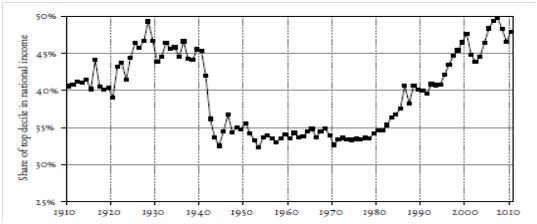
To βιβλίο του Piketty υποστηρίζει ότι η συρρίκνωση της μεσαίας τάξης δεν είναι ένα πρόσκαιρο φαινόμενο που διογκώθηκε από την κρίση του 2008, αλλά μια τάση των τελευταίων σαράντα ετών που αντανακλά βαθύτερες δυνάμεις των καπιταλιστικών κοινωνιών. Το βασικό συμπέρασμα του βιβλίου είναι ότι την τριακονταετία 1945-1975 οι εφαρμοζόμενες πολιτικές στις ανεπτυγμένες κοινωνίες περιόρισαν τις εισοδηματικές ανισότητες, αλλά από το 1980 και έπειτα το χάσμα της μεσαίας τάξης με την οικονομική ελίτ έχει διευρυνθεί σε προπολεμικά επίπεδα. Ως εκ τούτου, το «Capital in the 21st century» αποτελεί μια πολύτιμη πηγή επιχειρημάτων για όσους θεωρούν ότι δεν υπάρχει κάποιο αόρατο χέρι που θα κλείσει αυτόματα την ψαλίδα και επιμένουν να ζητούν τη λήψη μέτρων από τις κυβερνήσεις.

H έρευνα του Piketty 

To «Capital in the 21st century» βασίζεται στην πολυετή έρευνα του Piketty σε φορολογικά αρχεία και καταγράφει την ιστορική εξέλιξη στη συγκέντρωση του κεφαλαίου και του εισοδήματος από την έναρξη της βιομηχανικής επανάστασης μέχρι σήμερα.
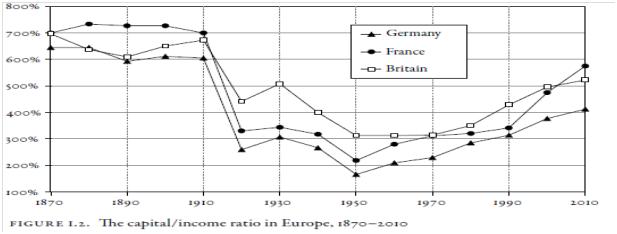
H έρευνα του Piketty δείχνει ότι τoν 18ο και τον 19ο αιώνα οι βιομηχανικές κοινωνίες χαρακτηρίζονταν από υψηλή εισοδηματική ανισότητα, ο ιδιωτικός πλούτος ήταν συγκεντρωμένος στα χέρια λίγων πανίσχυρων οικογενειών και υπερέβαινε κατά πολύ το ετήσιο εθνικό εισόδημα.
Τα κέρδη του κεφαλαίου αυξάνονταν, ενώ οι μισθοί των εργατών παρέμεναν σταθεροί σε χαμηλά επίπεδα. Oι δύο παγκόσμιοι πόλεμοι διατάραξαν την ισορροπία αυτή και ως το 1950 η ανισότητα είχε περιοριστεί σημαντικά, με τη συγκρότηση του κράτους πρόνοιας και την αύξηση των φόρων στα ανώτερα εισοδήματα και στον πλούτο. Οι μισθοί της μεσαίας τάξης αυξήθηκαν και ο λόγος του κεφαλαίου προς το εθνικό εισόδημα υποχώρησε. Ωστόσο, η τάση μείωσης των ανισοτήτων κράτησε μόνο στη λεγόμενη χρυσή τριακονταετία του καπιταλισμού. Από το 1975 η οικονομική ελίτ αυξάνει σταθερά το εισόδημά της, ενώ η μεσαία τάξη βρίσκεται σε στασιμότητα και έχει επωφεληθεί ελάχιστα από την αύξηση του ΑΕΠ των ανεπτυγμένων οικονομιών.
Η ανάλυση εστιάζει σε δύο δυνάμεις που οδηγούν στην αύξηση των ανισοτήτων. Η πρώτη δύναμη αφορά τη δυνατότητα των ανώτατων μισθωτών να διαχωρίζουν τη θέση τους από τους υπόλοιπους εργαζομένους. Ο Piketty αναφέρεται κυρίως στα ανώτατα στελέχη των μεγάλων επιχειρήσεων, τους super managers. Η δεύτερη δύναμη, την οποία ο Γάλλος οικονομολόγος εκφράζει με τη μορφή του θεμελιώδους νόμου r>g, αφορά τη σχέση του κεφαλαίου προς το εθνικό εισόδημα. Σύμφωνα με τον Piketty, το ποσοστό κέρδους του κεφαλαίου (r) τείνει να είναι μακροπρόθεσμα μεγαλύτερο από τον ρυθμό ανάπτυξης της οικονομίας (g).
Η σχέση αυτή σημαίνει ότι ο ο κληρονομημένος πλούτος αναπτύσσεται με ταχύτερο ρυθμό από το εισόδημα. Οι άνθρωποι με κληρονομημένο πλούτο χρειάζεται να αποταμιεύσουν μόνο ένα μικρό μέρος των κερδών από το κεφάλαιό τους για να δουν το κεφάλαιο αυτό να μεγαλώνει πιο γρήγορα από το σύνολο της εθνικής οικονομίας. «Υπό τις συνθήκες αυτές, είναι σχεδόν αναπόφευκτο ότι ο κληρονομημένος πλούτος θα κυριαρχήσει με μεγάλη διαφορά του πλούτου που έχει αποκτηθεί από την εργασία μιας ολόκληρης ζωής και η συγκέντρωση του κεφαλαίου θα φτάσει σε πολύ υψηλά επίπεδα, πιθανότατα ασύμβατα με τις αξιοκρατικές αρχές και αξίες της κοινωνικής δικαιοσύνης, που είναι θεμελιώδεις στις σύγχρονες δημοκρατικές κοινωνίες» γράφει ο Piketty.
O συγγραφέας παρουσιάζει την εξέλιξη των ανισοτήτων στις ΗΠΑ και στην Ευρώπη, βασιζόμενος στην πρώτη και στη δεύτερη δύναμη αντίστοιχα.
Στις ΗΠΑ, το ανώτατο 1% απολάμβανε ως το 1940 πάνω το 45% του εθνικού εισοδήματος. Το 1970 το μερίδιο του πλουσιότερου 1% υποχώρησε λίγο χαμηλότερα από το 30% και το 2010 επανήλθε πάνω από το 45%.
Στη Γαλλία, στη Γερμανία και στη Βρετανία, το κεφάλαιο ήταν επτά φορές υψηλότερο από το ετήσιο εθνικό εισόδημα από το 1700 ως το 1910. Στη συνέχεια ο λόγος του κεφαλαίου προς το εθνικό εισόδημα σημείωσε μεγάλη πτώση, υποχωρώντας το 1950 στο 1,5 στη Γερμανία, στο 2,5 στη Γαλλία και στο 3 στη Βρετανία. Από το 1970 άρχισε και πάλι να αυξάνεται, φτάνοντας το 2010 λίγο πάνω από το 5 στη Βρετανία και λίγο κάτω από το 6 στη Γαλλία. Στη Γερμανία βρίσκεται κάπου στο 4.
Σημειώνεται ότι στο κεφάλαιο (έννοια που χρησιμοποιεί εναλλάξ με αυτήν του πλούτου) ο Piketty περιλαμβάνει στοιχεία ενεργητικού όπως γη, μηχανές, ρευστό, ομόλογα, μετοχές, πνευματική ιδιοκτησία και για την εποχή της νόμιμης δουλείας ακόμα και ανθρώπους.
Oι κληρονόμοι «ραντιέρηδες» και η επέλαση των «super managers»

Η επιλογή του Piketty να παρουσιάσει την εξέλιξη των ανισοτήτων στις ΗΠΑ μέσα από τη θέση του ανώτατου 1% και στην Ευρώπη μέσα από τον λόγο του κεφαλαίου (πλούτου) προς το εισόδημα δεν είναι τυχαία.
Όπως γράφει, η πρώτη δύναμη διεύρυνσης των ανισοτήτων εμφανίστηκε τις τελευταίες δεκαετίες στις ΗΠΑ. Η αμερικάνικη κοινωνία είναι κοινωνία των super stars ή των super managers, που χαρακτηρίζεται από μεγάλη ανισότητα, η οποία έχει δημιουργηθεί κυρίως μέσω εισοδημάτων από εργασία και όχι από πλούτο. Αυτοί που βρίσκονται στην κορυφή της πυραμίδας, το 1%, βρέθηκαν εκεί μέσω υψηλών μισθών και απολαβών.
Αντίθετα η δεύτερη δύναμη διεύρυνσης των ανισοτήτων διαμόρφωσε τις ευρωπαϊκές κοινωνίες στην Βelle Epoque. Πρόκειται για τις κοινωνίες του πατρογονικού καπιταλισμού και των «ραντιέρηδων», όπου η κληρονομιά είναι πολύ σημαντική και η συγκέντρωση του πλούτου υπερβολικά υψηλή.

Πίσω στη χρυσή εποχή του καπιταλισμού

Η βασική θέση του Piketty για τις δυνάμεις διεύρυνσης των ανισοτήτων και η επιλογή να χρησιμοποιήσει τη λέξη «Κεφάλαιο» για τον τίτλο δεν πρέπει να οδηγούν στο συμπέρασμα ότι τάσσεται υπέρ της εγκατάλειψης του μοντέλου της ελεύθερης αγοράς για κάποια άλλη μορφή οικονομίας.
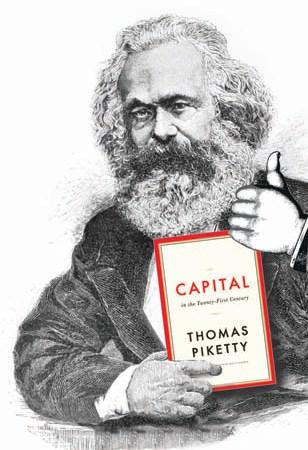
Σε συνέντευξή του στο ΝewStatesman δήλωσε ότι δεν έχει διαβάσει ποτέ πραγματικά το «Κεφάλαιο» του Μαρξ και ότι η σκέψη του Γερμανού φιλοσόφου δεν είχε καμία επίδραση στο έργο του. Σε αντίθεση με τον Μαρξ ο Piketty δεν πιστεύει στο αποκαλυπτικό τέλος του καπιταλισμού και υποστηρίζει ότι υπάρχει μια μέση οδός για τη μείωση των ανισοτήτων και την επίτευξη μεγαλύτερης αρμονίας μεταξύ των τάξεων.
«Δυστυχώς για τους ανθρώπους που παγιδεύτηκαν σε αυτά τα ολοκληρωτικά πειράματα, το πρόβλημα ήταν πως η οικονομία της αγοράς και η ιδιωτική περιουσία δεν χρησιμεύουν μόνο στη διασφάλιση της κυριαρχίας του κεφαλαίου πάνω σε αυτούς που δεν έχουν να πουλήσουν τίποτε άλλο πέρα από την εργατική τους δύναμη. Διαδραματίζουν και έναν σημαντικό ρόλο στην οργάνωση των ενεργειών εκατομμυρίων προσώπων και δεν είναι τόσο εύκολο να κάνουμε χωρίς αυτέςΟι ανθρώπινες καταστροφές του σοβιετικού τύπου κεντρικού σχεδιασμού το δείχνουν αυτό ξεκάθαρα» γράφει ο Piketty.
Στο τελευταίο μέρος του «Capital in the 21st century» προτείνει μέτρα όπως η αύξηση της φορολογίας για τα ανώτατα εισοδήματα και η επιβολή ενός προοδευτικού φόρου περιουσίας.
Συγκεκριμένα, ο Piketty τάσσεται υπέρ μιας προοδευτικής φορολογίας εισοδημάτων, με τον ανώτατο φόρο να αγγίζει ως και το 80% για το κορυφαίο 1% ή 0,5%. Σύμφωνα με τον ίδιο, ένας τόσο υψηλός φόρος σε εισοδήματα από $500.000 ως $1 εκατ. όχι μόνο δεν θα μείωνε την ανάπτυξη, αλλά θα οδηγούσε σε πιο δίκαιη διανομή. Η έρευνα του Piketty δείχνει ότι οι υπερβολικά υψηλές αμοιβές των στελεχών μετά τη δεκαετία του 1980 δεν δικαιολογούνται από την αύξηση της παραγωγικότητας.
Η ιδέα πίσω από έναν τέτοιο φόρο δεν είναι ότι θα αποφέρει πολλά έσοδα στην κυβέρνηση, αλλά ότι θα περιορίσει τα κίνητρα των στελεχών να ζητούν υπερβολικά υψηλές αμοιβές και θα οδηγήσει αυτόματα σε αύξηση των αμοιβών στις κατώτερες μισθολογικές βαθμίδες, από τη στιγμή που δεν θα υπάρξει κάποια επίπτωση στην ανάπτυξη.
Παράλληλα, ο Piketty προτείνει την επιβολή ενός παγκόσμιου φόρου στο κεφάλαιο. O φόρος θα ξεκινά από πολύ χαμηλά για μικρές περιουσίες και θα φτάνει στο 5% - 10% για περιουσίες που ανέρχονται σε δισεκατομμύρια δολάρια. Κατά τον ίδιο, ο φόρος στο κεφάλαιο είναι η καλύτερη απάντηση στην ανισότητα του r>g.

Οι επικρίσεις από «αριστερά» και «δεξιά»

Ένα από τα πιο εντυπωσιακά στοιχεία για το «Capital in the 21st century» είναι ο πραγματικά τεράστιος αριθμός των κριτικών που δημοσιεύτηκαν το τελευταίο διάστημα σε εφημερίδες, ακαδημαϊκά περιοδικά και blogs.
Την άποψή τους για το βιβλίο κατέθεσαν σχεδόν όλα τα μεγάλα ονόματα της οικονομικής επιστήμης, από τον Krugman και τον Rogoff, μέχρι τον James Galbraith και τον νομπελίστα Robert Solow. Στην πλειονότητά τους οι κριτικές είναι από θετικές ως διθυραμβικές.
Ωστόσο είναι πολλοί αυτοί που έχουν εντοπίσει σημαντικές αδυναμίες στο «Capital in the 21st century» και έχουν παρουσιάσει επιχειρήματα ενάντια στις θέσεις του Piketty. Από τα επιχειρήματα αυτά, είναι ενδιαφέρον να διακρίνει κανείς αυτά που προέρχονται από τα «αριστερά» και από τα «δεξιά». Η διάκριση αυτή είναι φυσικά απλώς ενδεικτική και έχει ως στόχο να καταγράψει τον πολιτικό αντίκτυπο που έχει το βιβλίο του Piketty.

O χρηματοοικονομικός τομέας και ο ευρύτερος ρόλος του κράτους

Η κριτική του Paul Krugman στους NYT για το «Capital in the 21st century» μόνο διθυραμβική μπορεί να χαρακτηριστεί. Ο νομπελίστας οικονομολόγος αναφέρει ότι ο Piketty έγραψε ένα εξαιρετικά σημαντικό βιβλίο, το οποίο μεταμόρφωσε την ακαδημαϊκή συζήτηση για τον πλούτο και την ανισότητα.
Αλλά ο Krugman επισημαίνει πως ανεξάρτητα από το πόσο σημαντικό είναι το βιβλίο, ο Piketty δεν δίνει όση βαρύτητα θα έπρεπε στον ρόλο του χρηματοοικονομικού τομέα στην αύξηση των ανισοτήτων.
Σε συνέντευξή του στο περιοδικό NewStatesman o Piketty δέχεται την κριτική του Krugman. «Ναι πιστεύω πως έπρεπε να δώσω μεγαλύτερη έμφαση στα χρηματοοικονομικά, αν και μίλησα για τη χρηματοοικονομική απορρύθμιση. Ίσως έπρεπε να κάνω κάτι παραπάνω. Ο Paul Krugman έχει δίκιο σε αυτό. Ένα ζήτημα είναι η αύξηση των απολαβών στον χρηματοοικονομικό τομέα. Το άλλο ζήτημα έχει να κάνει με το γεγονός ότι η απορρύθμιση έχει αυξήσει την ανισότητα στην πρόσβαση καλών ποσοστών κέρδους», ανέφερε.
Ωστόσο, η πιο συχνή αντίρρηση στο βιβλίο του Piketty δεν αφορά τον ρόλο του χρηματοοικονομικού τομέα, αλλά την πρότασή του για έναν παγκόσμιο φόρο στο κεφάλαιο (ή στον πλούτο). Πολλοί υποστηρίζουν πως η πρόταση αυτή δεν είναι ρεαλιστική και δεν μπορεί να εφαρμοστεί στο υφιστάμενο θεσμικό πλαίσιο. Από τη στιγμή που όσοι έχουν συσσωρεύσει πλούτο έχουν και μεγαλύτερη πολιτική επιρροή θεωρούν ότι είναι ουτοπικό να πιστεύει κανείς πως μπορεί να εφαρμοστεί ένας τέτοιος φόρος. Παράλληλα εκφράζουν την άποψη ότι ο Piketty εστιάζει υπερβολικά στη φορολογία και αγνοεί τον ευρύτερο ρόλο που μπορεί να έχει η κυβέρνηση στην προώθηση πιο εξισωτικών αποτελεσμάτων.
Μια άλλη ένσταση κατά του Piketty έχει να κάνει με τη θέση του ότι το ποσοστό κέρδους του κεφαλαίου θα συνεχίσει να αυξάνεται περισσότερο από τον ρυθμό αύξησης του ΑΕΠ. Ο νομπελίστας οικονομολόγος Robert Solow έγραψε ότι ο Piketty προσφέρει ιστορικά στοιχεία για τις τάσεις που έχουν επικρατήσει μέχρι σήμερα, αλλά δεν αποδεικνύει γιατί αυτό θα ισχύσει και στο μέλλον.
Μια άλλη κριτική από τα αριστερά εστιάζει στον ορισμό του κεφαλαίου από τον Piketty. Οικονομολόγοι όπως ο James Galbraith ασκούν κριτική στον νεοκλασικό ορισμό του κεφαλαίου από τον Piketty, ως ένα άθροισμα φυσικών αντικειμένων. Σύμφωνα με τον Galbraith ο ορισμός αυτός δεν συλλαμβάνει την ουσία του κεφαλαίου, η οποία είναι «η εξουσία που δίνει στους καπιταλιστές να λαμβάνουν αποφάσεις και η υπεραξία που λαμβάνουν από την εργασία».

Η αξία των super managers και oι αναπτυσσόμενες χώρες

Ένα βιβλίο για την ανισότητα που προτείνει αύξηση των φόρων για τα ανώτερα εισοδήματα είναι λογικό να προκαλέσει αντιδράσεις από τη «δεξιά». Πέρα από τις φωνές πανικού που προειδοποιούσαν για τη μόλυνση του δημόσιου λόγου από μαρξιστές επαναστάτες, οι αντιδράσεις αυτές μπορούν να συνοψιστούν στα εξής σημεία:
Πρώτον, oι υψηλές αμοιβές των ανώτατων στελεχών είναι δικαιολογημένες και αντανακλούν την παραγωγικότητα και τα ταλέντα τους. Οι πολύ υψηλοί μισθοί δεν είναι το αποτέλεσμα μεγαλύτερης επιρροής στα διοικητικά συμβούλια, αλλά της αξίας των super managers σε μια σύγχρονη επιχείρηση. Καταλυτικός εδώ θεωρείται ο ρόλος της ψηφιακής τεχνολογίας. Η ψηφιακή τεχνολογία αυξάνει το οριακό προϊόν των πιο ικανών σε όλα τα επιχειρηματικά πεδία, δημιουργώντας μια παγκόσμια ελίτ super stars που ξεχωρίζουν από τους υπόλοιπους χάρη στα ταλέντα τους.
Δεύτερον, ο Piketty υποτιμά τη συμβολή που θα έχουν στην παγκόσμια οικονομία αναπτυσσόμενες χώρες όπως η Κίνα και η Ινδία, η οποία μπορεί να κρατήσει τον ρυθμό ανάπτυξης υψηλότερα για την επόμενη εκατονταετία.
Tρίτον, το «Capital in the 21st century» δεν λαμβάνει υπόψη άλλους λόγους για τους οποίους αυξάνεται το ποσοστό κέρδους του κεφαλαίου και η ανισότητα, όπως η μαζική εισροή φθηνής εργασίας από αναπτυσσόμενες χώρες στις παγκόσμιες αγορές ή χρήση νέου τύπου ρομπότ στην παραγωγή.
Τέταρτον, ο Γάλλος οικονομολόγος κατηγορεί τον καπιταλισμό για αύξηση των ανισοτήτων, αλλά εστιάζει μόνο στις ανεπτυγμένες χώρες. Ωστόσο, σε παγκόσμιο επίπεδο οι ανισότητες έχουν συρρικνωθεί και αυτό οφείλεται στον καπιταλισμό. «Η ίδια μηχανή που έχει αυξήσει τις ανισότητες στις πλούσιες χώρες έχει κάνει το παιχνίδι πιο δίκαιο για δισεκατομμύρια ανθρώπους στον κόσμο» γράφει ο Kenneth Rogoff στην κριτική του για το βιβλίο.

H διαμάχη με τους Financial Times 

Tην περασμένη εβδομάδα ο οικονομικός συντάκτης των F.T. Chris Giles υποστήριξε πως το βιβλίο περιέχει λάθη στη μέθοδο ανάλυσης των στατιστικών στοιχείων. To δημοσίευμα προκάλεσε αμέσως αντιδράσεις.«Όχι τόσο γρήγορα με αυτό το νόμπελ» έγραψε στο twitter o συνάδελφος του Giles στους F.T. Clive Crook. «Αυτό είναι μεγάλο λαβράκι αν είναι αλήθεια: Λάθος τα δεδομένα του Piketty;» έγραψε ο Τim Fernholz του Quarz.
Σύμφωνα με τον κ. Giles τα λάθη αυτά υπονομεύουν το συμπέρασμα του Piketty ότι η οικονομική ανισότητα στην Ευρώπη και στις ΗΠΑ οδεύει σε επίπεδα που δεν έχουν εμφανιστεί από την εποχή του Β’ Παγκοσμίου Πολέμου. Μετά την διόρθωση των λαθών αυτών, «τα βασικά συμπεράσματα του βιβλίου -ότι η εισοδηματική ανισότητα έχει αρχίσει να αυξάνεται τα τελευταία 30 χρόνια και ότι οι ΗΠΑ έχουν πιο άνιση διανομή του πλούτου από την Ευρώπη- δεν φαίνεται να ισχύουν» γράφει ο κ. Giles.
O συντάκτης των F.T. χρησιμοποίησε τα υπολογιστικά φύλλα του excel που έχει δημοσιεύσει ο Piketty στην ιστοσελίδα του.
Σε επιστολή του στη βρετανική οικονομική εφημερίδα ο κ. Piketty έγραψε πως δημοσίευσε τα στοιχεία «για να προωθήσει έναν ανοιχτό διάλογο για αυτά τα σημαντικά και ευαίσθητα ζητήματα υπολογισμού».
Σε mail του στο Bloomberg χαρακτήρισε την ανάλυση των F.T. απλώς γελοία και τόνισε πως δεν υπάρχει κάποιο λάθος στη δουλειά του. Στο AFP ανέφερε ότι «εκεί που οι F.T. δεν είναι ειλικρινείς είναι όταν υποστηρίζουν ότι αυτό αλλάζει κάτι στα συμπεράσματα που βγάζω, όταν στην πραγματικότητα δεν αλλάζει τίποτα.
Οι πιο πρόσφατες μελέτες απλώς επιβεβαιώνουν τα συμπεράσματά μου, χρησιμοποιώντας διαφορετικές πηγές».
Στις 28 Μαΐου ο κ. Piketty δημοσίευσε μια ολοκληρωμένη απάντηση 4.400 λέξεων στην κριτική των F.T. Στην απάντηση αυτή αναφέρει μεταξύ άλλων: «Πρώτον, δεν βρήκα την κριτική των F.T. ιδιαίτερα εποικοδομητική. Οι F.T. υποστηρίζουν ότι έκανα λάθη και σφάλματα στους υπολογισμούς μας, το οποίο είναι απλώς λάθος, όπως δείχνω. Οι διορθώσεις που προτείνουν οι F.T. (και με τις οποίες διαφωνώ) είναι ως επί το πλείστον επουσιώδεις και δεν επηρεάζουν τις μακροπρόθεσμες προβλέψεις και τη γενικότερη ανάλυσή μου, αντίθετα από ό,τι υποστηρίζουν οι F.T. Eπιπλέον, οι διορθώσεις των F.T. που είναι κάπως πιο σημαντικές βασίζονται σε μεθοδολογικές επιλογές που είναι κάπως (μην πω τουλάχιστον) συζητήσιμες».
Ο κ. Krugman έγραψε στο blog του στους NYT πως ο κ. Piketty οφείλει να απαντήσει στις ερωτήσεις που θέτει ο συντάκτης των F.T., αλλά σε καμία περίπτωση δεν τίθεται θέμα για τα συμπεράσματα του Γάλλου οικονομολόγου. 
«Είμαι σίγουρος ότι τέτοια λάθη συμβαίνουν όλη την ώρα. Τις περισσότερες φορές είναι έντιμα λάθη που δεν αλλάζουν τα βασικά συμπεράσματα» ανέφερε ο Dani Rodrik, καθηγητής στο Princeton.
«Πιστεύω ότι ο Piketty πρέπει να εξηγήσει κάποια πράγματα, όπως γιατί έγιναν οι προσαρμογές», υποστήριξε ο Branko Milanovic, επισκέπτης καθηγητής στο πανεπιστήμιο της Νέας Υόρκης και οικονομολόγος στην Παγκόσμια Τράπεζα.

http://www.euro2day.gr/specials/topics/article/1214854/thomas-piketty-o-karl-marx-toy-21oy-aiona.html

_________________________________________

Το σημείωσα όταν πρωτοέγραψα για τον Πικετύ:
Στην Ελλάδα αναπαράγεται εδώ και δεκαετίες το ακόλουθο κλισέ
"Για να βγάλεις λεφτά πρέπει είτε να κληρονομήσεις είτε να καλοπαντρευτείς ή να κλέψεις (νόμιμα ή όχι)"

Όσον αφορά τον Μαρξ, υπάρχουν σημερινοί μελετητές του, πχ ο Wolff, ο οποίος ήταν και καθηγητής των Παπανδρέου - Σαμαρά, που έχουν δημιουργήσει τις βασικές καμπύλες και διακρίνεται το μοτίβο που περιγράφει ο Πικετύ: "κάτι συνέβη" από τη δεκαετία του '70 και από τότε η αμοιβή της εργασίας δεν ακολουθεί την παραγωγικότητά της.


ας μην συνεχίσουμε με υποανάπτυκτα πράγματα όπως πετρέλαιο και χρέος

10.1.09

Banking Crises

Banking Crises: An Equal Opportunity Menace
Carmen M. Reinhart
University of Maryland, NBER and CEPR
Kenneth S. Rogoff
Harvard University and NBER
December 17, 2008

Για όποιον ενδιαφέρεται

23.11.08

Το σκάσιμο της «φούσκας» και η παγκόσμια ανάκαμψη

Η παγκόσμια οικονομική κρίση θα περάσει στην ιστορία ως λάθος του Γκρίνσπαν. Πρόκειται για μια κρίση, για την οποία ευθύνεται, κυρίως, το συμβούλιο αξιωματούχων της Φέντεραλ Ριζέρβ, στη διάρκεια της εποχής εύκολου χρήματος και χαλαρού ρυθμιστικού πλαισίου στο χρηματοοικονομικό τομέα, μια εποχή που διήρκεσε από τα μέσα της δεκαετίας του '90 μέχρι σήμερα.

Η πολιτική εύκολου χρήματος, η οποία είχε την υποστήριξη ρυθμιστικών αρχών που στην πραγματικότητα απέτυχαν στη σύσταση ενός πλαισίου κανόνων, δημιούργησε άνευ προηγουμένου «φούσκες» στους τομείς κατοικιών και καταναλωτικής πίστης σε ΗΠΑ, αλλά και σε άλλες χώρες, κυρίως εκείνες τις χώρες που είχαν υιοθετήσει τακτικές ανάλογες με την πολιτική των ΗΠΑ.

Και η «φούσκα» έχει πλέον σκάσει και αυτές οι οικονομίες οδεύουν προς βαθιά οικονομική ύφεση. Και στον «πυρήνα» της κρίσης βρίσκεται η υπερβολική άνοδος μετοχικών αξιών και τιμών κατοικιών, μια άνοδος που είχε παρεκκλίνει σε μεγάλο βαθμό από τα ιστορικά δεδομένα. Ο κ. Γκρίνσπαν δημιούργησε δύο φούσκες -τη φούσκα εταιρειών Διαδικτύου, κατά το χρονικό διάστημα 1998-2001 και τη φούσκα στην αγορά κατοικιών, που έσκασε πρόσφατα.

Και στις δύο περιπτώσεις, η υπερβολική αύξηση στην αξία στοιχείων ενεργητικού έκανε τα αμερικανικά νοικοκυριά να σκεφθούν ότι είχαν γίνει πλούσια, με τους Αμερικανούς να μπαίνουν στον πειρασμό να αυξήσουν δυσανάλογα δανεισμό και δαπάνες -για σπίτια, αυτοκίνητα και άλλα καταναλωτικά διαρκή αγαθά.

Και οι χρηματοοικονομικές αγορές ήταν πρόθυμες να δανείσουν σε αυτά τα νοικοκυριά, εν μέρει διότι οι πιστωτικές αγορές λειτουργούσαν κάτω από ένα χαλαρό ρυθμιστικό πλαίσιο, το οποίο εξυπηρετούσε ως «πρόσκληση» για ανεύθυνο δανεισμό.

Και εξαιτίας του κλίματος ευημερίας σε χρηματιστήρια και αγορά στέγης, το καθαρό εισόδημα των αμερικανικών νοικοκυριών αυξήθηκε περίπου κατά 18 τρισ. δολάρια στη διάρκεια των ετών 1996-2006. Και η ενίσχυση της κατανάλωσης με βάση αυτόν τον πλούτο συνέβαλε σε περαιτέρω αύξηση των τιμών στέγης, πείθοντας νοικοκυριά και δανειστές να τροφοδοτήσουν ακόμη περισσότερο τη φούσκα.

Και κάποια στιγμή, όλα αυτά άρχισαν να καταρρέουν. Οι τιμές κατοικιών έφθασαν στα ανώτατα επίπεδα το 2006, και οι τιμές των μετοχών το 2007. Και με την κατάρρευση της φούσκας σε χρηματιστήριο και αγορά στέγης, τίτλοι περιουσιακών στοιχείων αξίας που ενδεχομένως να φθάνει και τα δέκα τρισ. δολάρια -ή μέχρι και τα 15 τρισ. δολάρια- θα καταστούν άχρηστοι.

Ορισμένα πολύπλοκα πράγματα συμβαίνουν ταυτοχρόνως.

Πρώτον, τα νοικοκυριά μειώνουν σε μεγάλο βαθμό τις καταναλωτικές τους δαπάνες, καθώς αισθάνονται -και συμβαίνει πράγματι- πολύ φτωχότερα εν συγκρίσει με την οικονομική τους κατάσταση πριν από ένα χρόνο.

Δεύτερο, ορισμένοι χρηματοοικονομικοί οργανισμοί υψηλής επιρροής, όπως η Bear Stearns και η Lehman Brothers κατέρρευσαν, σε μια εξέλιξη που συντέλεσε σε μεγαλύτερη απώλεια πλούτου (στους μετόχους και πιστωτές των συγκεκριμένων χρηματοπιστωτικών ιδρυμάτων) όπως και μεγαλύτερο περιορισμό των δανείων που κάποτε παρείχαν αυτές οι εταιρείες.

Τρίτον, οι εμπορικές τράπεζες έχασαν πολλά από ριψοκίνδυνες συναλλαγές, με το μεγαλύτερο μέρος του κεφαλαίου τους να εξανεμίζεται. Και την ώρα που η κεφαλαιακή τους βάση συρρικνώνεται, μειώνονται αναλόγως και τα μελλοντικά τους δάνεια.

Τέταρτο και τελευταίο, η κατάρρευση της Lehman Brothers και η παρ' ολίγον κατάρρευση του ασφαλιστικού ομίλου AIG προκάλεσαν έναν χρηματοοικονομικό «πανικό», στο πλαίσιο του οποίου ακόμη και οι οικονομικά υγιείς εταιρείες δεν είναι σε θέση να εξασφαλίσουν βραχυπρόθεσμα τραπεζικά δάνεια ή να πωλήσουν βραχυπρόθεσμο εταιρικό χρέος.

Η πρόκληση για τους διαμορφωτές πολιτικής είναι να αποκαταστήσουν την επενδυτική εμπιστοσύνη σε τέτοιο βαθμό που να μπορούν και πάλι οι επιχειρήσεις να εξασφαλίσουν βραχυπρόθεσμη πίστωση, ώστε να καλύψουν τις ανάγκες μισθοδοσίας εργαζομένων και να χρηματοδοτήσουν τα αποθέματά τους. Η επόμενη πρόκληση είναι τα μέτρα για την αποκατάσταση του κεφαλαίου των τραπεζών, έτσι ώστε οι εμπορικές τράπεζες να μπορούν και πάλι να παρέχουν δάνεια για μακροπρόθεσμες επενδύσεις.

Αλλά αυτά τα βήματα -όσο αναγκαία και αν είναι- δεν πρόκειται να αποτρέψουν την ύφεση στις ΗΠΑ και άλλες χώρες που έχουν υποστεί πλήγμα λόγω πιστωτικής κρίσης.

Οι αγορές κατοικιών και μετοχών δεν αναμένεται να ανακάμψουν σε σύντομο χρονικό διάστημα. Κατά συνέπεια, τα νοικοκυριά είναι φτωχότερα και θα περιορίσουν ακόμη περισσότερο τις δαπάνες, καθιστώντας -βραχυπρόθεσμα- αναπόφευκτη την ύφεση.

Οι ΗΠΑ θα υποστούν το ισχυρότερο πλήγμα, αλλά και άλλες χώρες με «φούσκες» σε αγορές κατοικιών και υπερβολική κατανάλωση (φούσκες που όμως έχουν σκάσει) -ειδικότερα Βρετανία, Ιρλανδία, Αυστραλία, Καναδάς και Ισπανία- αναμένεται να δεχθούν πλήγμα.

Η Ισλανδία, που ιδιωτικοποίησε και απελευθέρωσε τις τράπεζές της πριν από μερικά χρόνια, τώρα βρίσκεται στα πρόθυρα εθνικής χρεοκοπίας, διότι οι ισλανδικές τράπεζες δεν θα είναι σε θέση να αποπληρώσουν τους ξένους πιστωτές από τους οποίους είχαν πάρει μεγάλα δάνεια.

Και δεν αποτελεί σύμπτωση το γεγονός ότι -με εξαίρεση την Ισπανία- όλες αυτές οι χώρες είχαν υιοθετήσει την αμερικανική φιλοσοφία των ελεύθερων αγορών και των χαλαρών ρυθμιστικών πλαισίων για τα χρηματοοικονομικά συστήματα.

Όμως παρά τα προβλήματα που αντιμετωπίζουν οι αγγλο-σαξονικού τύπου οικονομίες, κανένα δεν είναι τόσο σοβαρό που να εγκυμονεί τον κίνδυνο παγκόσμιας οικονομικής καταστροφής. Δεν διακρίνω κάποιο λόγο για ύφεση της παγκόσμιας οικονομίας, ούτε καν για επιβράδυνση της παγκόσμιας οικονομίας.

Ναι, οι ΗΠΑ θα βιώσουν μια φάση μείωσης του εισοδήματος και δραματικής αύξησης της ανεργίας, περιορίζοντας τις εξαγωγές των υπολοίπων χωρών του κόσμου προς τις ΗΠΑ. Αλλά οι οικονομίες σε πολλά άλλα μέρη της Γης συνεχίζουν και αναπτύσσονται. Πολλές μεγάλες οικονομίες -συμπεριλαμβανομένης Κίνας, Γερμανίας, Ιαπωνίας και Σαουδικής Αραβίας- διαθέτουν πολύ μεγάλα πλεονάσματα εξαγωγών, έχοντας έτσι τη δυνατότητα να δανείζουν στον υπόλοιπο κόσμο (και ειδικότερα τις ΗΠΑ) αντί να δανείζονται χρήματα.

Αυτές οι χώρες έχουν μεγάλες ποσότητες μετρητών και δεν επιβαρύνονται από την κατάρρευση μιας φούσκας στην αγορά κατοικιών. Παρόλο που τα νοικοκυριά τους κατά κάποιον τρόπο έχουν υποστεί πλήγμα από την υποχώρηση των μετοχικών αξιών, όχι μόνο έχουν τα περιθώρια να συνεχίσουν να αναπτύσσονται, αλλά μπορούν να αυξήσουν την εσωτερική ζήτηση ώστε να αντισταθμίσουν τη μείωση της εξαγωγικής δραστηριότητας προς τις ΗΠΑ.

Θα πρέπει να μειώσουν τους φόρους, να χαλαρώσουν τις προϋποθέσεις δανεισμού και να αυξήσουν τις κρατικές επενδύσεις σε δρόμους, ηλεκτρική ενέργεια και στέγαση. Οι χώρες αυτές διαθέτουν αρκετά μεγάλα αποθέματα ξένου συναλλάγματος, ώστε να αποφύγουν τον κίνδυνο χρηματοοικονομικής αποσταθεροποίησης λόγω της αύξησης των δαπανών στην εγχώρια αγορά, αρκεί να κινηθούν με σύνεση.

Όσο για τις ΗΠΑ, το αδιαμφισβήτητο βάρος που επωμίζονται εκατομμύρια Αμερικανοί -βάρος που θα μεγαλώσει την επόμενη χρονιά, καθώς αυξάνεται η ανεργία- αποτελεί μια καλή ευκαιρία για επανεξέταση του οικονομικού μοντέλου που υιοθετήθηκε επί εποχής του προέδρου Ρίγκαν, το 1981.

Οι χαμηλοί φόροι και το χαλαρό ρυθμιστικό πλαίσιο συνέβαλε σε μια «ευφορία» καταναλωτικών δαπανών που ήταν ωραία όσο διήρκεσε, αλλά παράλληλα δημιούργησε τεράστια ανισότητα μεταξύ των εισοδημάτων, διόγκωση του ξένου δανεισμού, συνέβαλε στην παραμέληση του περιβάλλοντος και των έργων υποδομής, συντελώντας στο τεράστιο χρηματοοικονομικό χάος των ημερών. Έχει έλθει ο καιρός για μια νέα οικονομική στρατηγική -στην ουσία, για μια Νέα Συμφωνία.

JEFFREY D. SACHS, καθηγητής οικονομικών και επικεφαλής του Earth Institute, στο Πανεπιστήμιο Κολούμπια. Παράλληλα, ασκεί καθήκοντα ειδικού συμβούλου του γενικού γραμματέα του ΟΗΕ, αναφορικά με τους αναπτυξιακούς στόχους της χιλιετίας.

Copyright: Project Syndicate, 2008.

13.11.08

The first casualty of the crisis: Iceland

Iceland’s banking system is ruined. GDP is down 65% in euro terms. Many companies face bankruptcy; others think of moving abroad. A third of the population is considering emigration. The British and Dutch governments demand compensation, amounting to over 100% of Icelandic GDP, for their citizens who held high-interest deposits in local branches of Icelandic banks. Europe’s leaders urgently need to take step to prevent similar things from happening to small nations with big banking sectors.
Jon Danielsson
η συνέχεια
http://www.voxeu.org/index.php?q=node/2549

23.9.08

Πιστωτικές κρίσεις

O κατάλογος 42 πιστωτικών/τραπεζικών κρίσεων σε όλο το κόσμο.

The humbling of the Fed (wonkish)

Paul Krugman on the Paulson-Bernake bailout

A bit off the Paulson plan topic, but not entirely …
Not a day has gone by since this crisis began that I haven’t been thankful that Ben Bernanke is the chairman of the Fed; had events gone a bit differently (thank you Harriet Meiers!) the post might well have gone to some unqualified Bush loyalist.
That said, the Fed’s experience in this crisis has been humbling; getting traction has proved harder than BB himself suggested in his pre-crisis writings. Here are my thoughts on why.

So: we usually don’t think of it this way, but the Fed can be seen simply as one of many players in the financial market. It’s a very big player, but not that big compared with the market as a whole — the Fed has roughly $800 billion each of assets and liabilities, in a $50 trillion credit market. And conventional monetary policy consists, basically, of enlarging or contracting the Fed’s balance sheet. Why does the size of a financial player constituting less than 2 percent of the credit market matter?
The answer is that the Fed’s liabilities are special: nobody else has the right to create monetary base, which can in turn be used either as currency or as bank reserves. When the Fed expands the money supply, the key thing isn’t that it’s buying Treasury bills, it’s the fact that it’s doing so by expanding the monetary base, which increases liquidity to the economy as a whole.
But in March, and again this week, interest rates on T-bills fell close to zero — liquidity trap territory. What does that do to the Fed’s role?
You still see people saying, in effect, “never mind the zero interest rate, why not just print more money?” Actually, the Bank of Japan tried that, under the name “quantitative easing;” basically, the money just piled up in bank vaults. To see why, think of it this way: once T-bills have a near-zero interest rate, cash becomes a competitive store of value, even if it doesn’t have any other advantages. As a result, monetary base and T-bills — the two sides of the Fed’s balance sheet — become perfect substitutes. In that case, if the Fed expands its balance sheet, it’s basically taking away with one hand what it’s giving with the other: more monetary base is out there, but less short-term debt, and since these things are perfect substitutes, there’s no market impact. That’s why the liquidity trap makes conventional monetary policy impotent.
But why not purchase stuff other than T-bills? This can be thought of as changing the composition of the Fed’s balance sheet, rather than enlarging it; and Ben Bernanke, in happier days, thought that might be an effective policy in a liquidity trap.
There are, however, three reasons to be doubtful about this stuff:
1. The Fed is now trying to move a much bigger rock: it is, in effect, trying to raise the price of financial assets other than T-bills by selling T-bills and buying other stuff. There’s only (yes, “only”) $800 billion of monetary base. There are, by contrast, many trillions of stuff other thanT-bills, so the Fed has to make huge changes in its balance sheet to achieve any noticeable effect.
2. T-bills and other assets, such as long-term bonds, are probably much better substitutes for each other than T-bills are for monetary base — money is unique as a medium of exchange, whereas once you get past that you’re only talking about competing stores of value. So it should take much larger changes in relative supplies to get major changes in asset prices.
3. The reason T-bills are an imperfect substitute for, say, corporate bonds — to the extent they are — is risk. Therefore, the reason changing the composition of the Fed’s balance sheet can move prices, to the extent it can, is because the Fed is taking on risk. This isn’t a role the central bank is meant to play; you’re sliding over into fiscal policy.

Nonetheless, I guess the Fed had to try the “Bernanke twist.” And it did — the old Fed balance sheet, in which T-bills were the vast bulk of assets, is no more. But the effects have been disappointing, especially weighed against the risk, which I know is making Fed officials very nervous.
And now, with the Paulson plan — about which I have my doubts — responsibility is clearly shifting from the Fed to the fiscal authorities.
So Ben Bernanke came into his current position believing that central banks have the power, all on their own, to fight Japan-type problems. It seems that he was wrong.

22.9.08

O Krugman λέει No Deal

O Κrugman λέει No deal στο σχέδιο Paulson!

I hate to say this, but looking at the plan as leaked, I have to say no deal. Not unless Treasury explains, very clearly, why this is supposed to work, other than through having taxpayers pay premium prices for lousy assets.

η συνέχεια

19.9.08

Robert Shiller of Yale University talks with EconTalk host Russ Roberts

Shiller argues that the decade-long run up in housing prices was a bubble where speculative fervor outweighed any economic fundamentals. He also discusses the genesis of the Case-Shiller housing price index and his idea for how it might be used to reduce risk in the mortgage market.
http://www.econlib.org/library/Downloads/y2008/Shillerhousing.mp3
Note: This podcast was recorded on September 5, 2008

0:36
Intro. Current crisis in housing market. Great Depression: We pulled together in many different ways. Spirit that we are going to solve this problem together will keep it from being worse. Capitalism is a wonderful invention, has to have a popular sense that we all support this and it's all for us. What's disturbing about the current crisis is the sense that some people are being ill-treated. Who are those folks? Complicated. Many crises in history don't make any sense. This one driven by a sequence of speculative bubbles, stock market bubble, interrupted in 2000, 2003; housing. What is a bubble? Usual definition: Unwarranted asset price boom, not related to fundamentals. Defined by the fact that it will burst. P. 2 of Irrational Exuberance, DSM definition, hard to define a mental illness so you list symptoms that are characteristic of that syndrome but not necessarily all present. Situation where there are a sequence of price rises for a speculative asset which generates a social epidemic, generates contagion, certain ideas that become prominent. New era stories, envy, trading successes become prominent in people's ideas, sense of your self changes for a while, become more self-confident because you think you've discovered your investing genius. Why does it end? It can't go on forever. Prices are rising because people expect them to rise further. Someone will want to sell. Idea of a bubble goes back hundreds of years.
6:07
Role of psychology, behavioral approach. Explanations are easier ex post than ex ante. At the time there are some effects that are consistent with the price rise. How do you distinguish which ones are psychological? A matter of enlightenment. If you think about bubbles as a phenomenon you will learn earlier to recognize them. People did recognize this bubble. That's what ends them. If you think you are wiser than the herd, there is a temptation to ride the rise upward, so long as you can bail out at the right time. Part of the reason why bubbles are so inscrutable. Recent real estate bubble went on for 6 years. Not going to change over night. Can get in for a short time safely. Only those left in at the end get hurt. Transactions costs of moving in and out of the housing market are much higher than the stock market.
10:13
Challenge the idea that there was a bubble. Subprime aspect: Two ways to think about the current housing market: bubble that pops, systemic effects, or that it may have had some bubbly aspects but the crisis part is in the subprime market where foreclosures play a human side to the story, securitization. Speculative boom, major historical event; multiple causes, always other factors. One other factor relevant to the recent boom, Reagan revolution, newfound respect for free markets, 1980, depository institutions deregulation and monetary control act eliminated ceilings on mortgage loans and created a possibility of a subprime industry. Before that it was a government industry because you couldn't charge a high rate. Good thing to let markets function, but there wasn't the accustomed regulation of these new lenders. As the 1990s wore on they were operating in a bubble atmosphere. At the same time, innovating, including the securitization of them. Seems like a good thing. When bad things happen in history it's difficult to point a finger of blame. Compromises. General assumption, received conventional wisdom, was that home prices can never fall; distorted into home prices are the best investment ever; everyone should get leveraged. Leverage pushed it up to a tremendous rate of profit. Infomercials at night; rang true. Idea that there could be a crash in home prices didn't sound real. Famine or another black plague. Sounded like a money machine even to rational people. Failure to think about the bubble. Appears that a lot of financial institutions were incautious, assets became risky and eventually worthless. Banks found themselves holding collateral that wasn't very good. It happens all the time in a market economy; people make mistakes, take risks they were not aware of; lose their money, lose their jobs if a firm goes bankrupt. Why is this new or a crisis? Not fundamentally new. Not associated with benefits. Economies with financial markets have more booms and busts, goes with the advantages of markets. Book: Helping financial markets work better, expanding them, not contracting them.
18:26
Fed's role: did it have a role by lowering interest rates artificially, causing housing prices to go up? From 2002-2005, the real Federal Funds rate was negative, not such expansionary policy since the 1970s which had a smaller more localized housing boom. That is a part of the story. Other countries also had real estate booms where real rates were not so low, though. Even that story can be thought of as part of the same problem: they didn't see that there was any risk in the housing market. Alan Greenspan didn't see it as taking a big risk with the economy by keeping interest rates so low. Fall in housing prices is the biggest single event. High prices or low prices? When they are going up, everyone says it's great; but they forget the fact that a lot of people can now buy houses that they couldn't previously. What's the advantage of high home prices? Want to see economic growth, so you want to see incomes outpacing house prices. Alternative story, real side: Housing price run-up was largest in areas with increases in demand, Washington, D.C. area after 9/11; expansion due to Silicon area in CA. Prices reflect real side demand effects, coupled with zoning laws, etc. James Hamilton: decrease is not largest in areas with the biggest booms but in other areas, ones troubled by the subprime problem. Employment is positively correlated with home prices in a region: Michigan decline is related to the decline in the auto industry, which didn't have such a boom. Some places like Las Vegas, Phoenix, San Diego, Miami are areas with rapid price decline and were places that had big booms. Housing boom was substantially mirrored in places that have had housing bubbles before. Boom in 1920s in Florida, and CA in the 1980s. Sourdough explanation: something in the air. Markets are driven by stories. The idea that you are going to get rich in real estate isn't plausible in Milwaukee or Toledo, OH. Celebrity areas stimulate people's imaginations. Economists loosely throw around that fundamentals are driving everything. Can throw a lot of variables into a regression and make anything fit, called data mining.
27:34
Zoning laws: invented in Germany, late 19th century, new idea. City would lay out a map of the city with zones; each zone would be zoned for a certain kind of construction. If you wanted to deviate you had to go before a zoning board beforehand. Before 1920s not possible in the United States, till a Supreme Court decision; no authority for a city government to intrude on people's free use of their land. Even before zoning laws there were effective requirements, like anti-nuisance laws, after a person already built. Perception that zoning laws have gotten stronger, but not entirely clear that it's true. Future of enforcement of zoning laws is ephemeral and hard to judge. Part of the new era story. Challenge is that there are so many factors involved.
30:36
Data collection: Case-Shiller home price index. In late 1980s, Carl "Chip" Case rediscovered a method that had been used as early as the 1920s, improved it. Repeat sales home price indices. Most prominent index was the median home price. Problem with that is that the mix of homes changes, so sometimes a lot of homes on the west side of a town are selling and other times the east side. Volatile series. Instead, created an index that focused on the same set of homes. Astonishingly smooth over time. Incredible inefficiency of the home market. Stock market goes like a random walk; housing market goes in trends for years. Partly because of transactions costs; but also because nobody sees the data. Data went back to the 1970s, was electronic, punch cards. In 2nd edition of book, wanted to get a long historical series, so found some bits and pieces before that, from 1890 to the present. Not the last word, but it's the only one. Dirty work. One of the challenges is dealing with new home construction. Trend in U.S. has been toward dramatically larger houses. Once they are in the index it's controlled for. Macro Markets, do what people do with stock price index. It changes substantially over time, new companies start, old companies fail or merge. Wanted the indices to be tradeable, to represent the value of the housing stock, like S&P 500. Value weighted.
37:16
Index allows wise people to make money and not so wise people to take risks or lose money. Why would you call this a crisis, given that most of the time the housing market has been pretty smooth? Last few years, people made mistakes. Why should we worry about this relative to any other mistakes people make in their investing behavior? What is the systemic part of it? Systemic externality that operates both through institutional and psychological channels. 2007 when magnitude became palpable, we saw securities down dramatically, domino effect. Bernanke testified when Bear Stearns went under, could cause contagion that would spread. Justified Fed action, enhanced the power of the Fed, less than disinterested spectator. How do we know that we stood on the brink of a crisis? We don't know. We do know that there have been terrible crises in history, like the Great Depression. Protections like Deposit Insurance; and like the Federal Reserve which was set up in response to 1913 crisis. What if Bernanke had said: Let's let Bear Stearns fail? Over $50 trillion; one contract offset with another. Not safe if there is a major failure with a company that is involved in so many of those contracts. Crisis when trading suddenly stops; atmosphere of pessimism develops. Plausible that Bernanke is right.
43:07
Non-transparency: What we have right now is the Fed acting in an ad hoc, discretionary way. Bernanke is a scholar of the Great Depression; he certainly wouldn't want another one. Costs of avoiding such a depression are not borne by him but by all of us. Agency problems. At a time of a boom, the Fed is reluctant to say something that might squelch the boom or talk about risks lest they be blamed. Bernanke has a sense of public service. Difficult to make distinction. What would make financial markets work more effectively? 1. Improve financial information infrastructure; 2. expand the scope of markets so that more risks are traded; 3. improve retail products. Democratize finance. Take opportunity to continue the trend. Have to extend the scope of financial functioning so that it helps more and more people. Current situation is a failure to apply the basic principles of risk management well. People were encouraged to put leveraged investments into one city; undiversified use of their life savings, depending on Social Security. Mortgages that are risk managing for the homeowner: workout continuously, not only at crisis time. Mortgage payments indexed to home prices so that when home prices go down, mortgage balance and payments would go down. New standard. In 1930s, new standard, moving from 5-year rolling balloon payment mortgage to long term 15-30 years. Could have moved further forward. 2008 Housing and Recovery Act is an after-the-fact workout. Would a bank find that attractive? Futures markets for single-family home trading at Chicago Mercantile Exchange, but not very active. Mortgage issuers would be able to hedge themselves, international marketplace, spreading the risk. Same argument used for subprime market, securitization. Core idea was not the problem; it was the implementation. Financial education. Current crisis could cause a reversal of the good trends of democratization of finance. A lot of people are able to own homes.
53:16
Would a bank find such an instrument to be profitable? Banks and insurance companies: home equity insurance could be offered separately. Get enthusiastic responses, but we don't have a liquid market for a home price derivative. In the U.K. there is a lot of commercial derivative trading. We may see more willingness once they see the hedging markets. Financial markets have shown progress in every decade of the last century. Taping on Sept. 5, 2008. Book is 178 pages, non-technical, accessible treatment. Fairness and bailouts: Congress designed a band-aid with the Housing and Recovery Act. What if nothing happens beyond that? No political solution, no further band-aid expansion. Signs of a weakening world economy, home price debacles elsewhere. If we don't do anything we might be in for a serious recession. Japan-style outcome: risk of a slow economy for some time going forward. Risk of social bad feeling that expresses itself with unrest in labor markets and less willingness of entrepreneurs to take risks. Bad outcome but not as bad as the Great Depression. In Japan, the lost decade. Could be increases in prime rates. Hard to predict. Interesting times for economists.

Παγίδα ρευστότητας

The Liquidation Trap, by Thomas Palley:
The U.S. financial system is caught in a destructive liquidation trap that has falling asset prices cause financial distress, in turn compelling further asset sales and price declines. If unaddressed, it risks sending the economy into deep recession – or even depression.

17.9.08

Seven Deadly Sins of Deregulation -- and Three Necessary Reforms

Our current crisis is the result of the misguided notion that financial markets can regulate themselves. Here's a rundown of the mistakes we've made and the three reforms we need now.

The current carnage on Wall Street, with dire spillover effects on Main Street, is the result of a failed ideology -- the idea that financial markets could regulate themselves. Serial deregulation fed on itself. Deliberate repeal of regulations became entangled with failure to carry out laws still on the books. Corruption mingled with simple incompetence. And though the ideology was largely Republican, it was abetted by Wall Street Democrats.

Why regulate? As we have seen ever since the sub-prime market blew up in the summer of 2007, government cannot stand by when a financial crash threatens to turn into a general depression -- even a government like the Bush administration that fervently believes in free markets. But if government must act to contain wider damage when large banks fail, then it is obliged to act to prevent damage from occurring in the first place. Otherwise, the result is what economists term "moral hazard"-- an invitation to take excessive risks.

Government, under Franklin Roosevelt, got serious about regulating financial markets after the first cycle of financial bubble and economic ruin in the 1920s. Then, as now, the abuses were complex in their detail but very simple in their essence. They included the sale of complex securities packaged in deceptive and misleading ways; far too much borrowing to finance speculative investments; and gross conflicts of interest on the part of insiders who stood to profit from flim-flams. When the speculative bubble burst in 1929, sellers overwhelmed buyers, many investors were wiped out, and the system of credit contracted, choking the rest of the economy.

In the 1930s, the Roosevelt administration acted to prevent a repetition of the ruinous 1920s. Commercial banks were separated from investment banks, so that bankers could not prosper by underwriting bogus securities and foisting them on retail customers. Leverage was limited in order to rein in speculation with borrowed money. Investment banks, stock exchanges, and companies that publicly traded stocks were required to disclose more information to investors. Pyramid schemes and conflicts of interest were limited. The system worked very nicely until the 1970s -- when financial innovators devised end-runs around the regulated system, and regulators stopped keeping up with them.

Seven Deadly Sins

Sin One: Allowing Mortgage Lending to Become a Casino. Until 1969, Fannie Mae was part of the government. Mortgage lenders were tightly regulated. Homeownership rates soared throughout the postwar era, from about 44 percent on the eve of World War II to 64 percent by the mid-1960s. Nobody in the mortgage business got filthy rich, and hardly anyone lost money. Fannie's job was to buy mortgages from banks and thrift institutions, to replenish their money to make mortgages, and along the way to set standards. Fannie financed its operations by selling bonds. In the late 1970s, private Wall Street firms started emulating Fannie. They packaged mortgages, and converted them into bonds. Over time, their standards deteriorated, because they could make more money creating riskier products. In order to avoid losing market share, Fannie emulated some of the same abuses. Government did not step in to regulate the affair -- which was a time bomb waiting for the creation of the sub-prime mortgage business.

Sin Two: Allowing Unregulated Bond Rating Agencies to Decide What was Safe. Sub-prime is only the best known of a widespread fad known as "securitization." The idea is to turn loans into bonds. Bonds are given ratings by private companies that have official government recognition, such as Moody's and Standard and Poors, but no government regulation. These rating agencies have become thoroughly corrupted by conflicts of interest. If you want to package and sell bonds backed by risky loans, you go to a bond-rating agency and pay it a hefty fee. In return, the agency helps you manipulate the bond so that it qualifies for a triple-A rating, even if the underlying loans include many that are high-risk. Without the collusion of the bond-rating agencies, sub-prime lending never would have gotten off the ground, because it would not have found a mass market. Had regulators looked inside this black box, they would have shut it down. They might have needed new legislation, but they never asked for it. And public-minded regulators might have done a lot under existing law, since banks (which are regulated) were heavily implicated in the financing of sub-prime.

Sin Three: Failing to Police Sub-prime. The core idea of bank regulation is that government inspectors periodically examine the quality of bank assets. If too large a portion of a bank's loan portfolio is behind in its interest payments, the bank is made to raise more capital as a cushion against losses. Problems are nipped in the bud. But complex securities require more sophisticated regulation than simple loans. Regulators basically waived the rule on adequate capital for the new wave of mortgage lenders who created sub-prime. Many mortgage companies were not banks. They made loans only to sell them off to the Wall Street sinners of Deadly Sin No. 1 (see above). So there was no loan portfolio to examine, and no real capital. The Democratic Congress anticipated this problem in 1994, when it passed the Homeownership Opportunity and Equity Protection Act. This prescient law required the Federal Reserve to regulate the loan-origination standards of mortgage companies that were not otherwise government-regulated. But Alan Greenspan, a free-market zealot, never implemented the law. And when Republicans took over Congress in 1995, they never called him on the carpet.

Sin Four: Failure to Stop Excess Leverage. The financial economy is crashing today because so much speculation was done with borrowed money. A typical leverage ratio of a hedge fund or private equity company is 30 to one. That means $30 of debt for $1 of actual capital. If you make one serious miscalculation, you are out of business. And in the case of sub-prime mortgage companies, the leverage ratio was infinite, because they had no capital. The game was entirely based on creating debt. As long as times were good, financial firms could keep borrowing to finance their deals. But once investors looked down, they panicked. Some parts of the system are unregulated, such as hedge funds and private-equity companies. But they all ultimately get a lot of their funding from banks. And regulators do retain the power to look closely at banks' books (see Sin No.3 above). Had they used that power to police the kind of highly risky stuff banks were underwriting, they could have shut it down.

Sin Five: Failure to Police Conflicts of Interest. Remember the accounting scandals of the 1990s? In those scandals, accounting firms were paid once to audit corporate books and then again to help clients cook the books and still pass muster with the audit. That was a sheer conflict of interest. Though accountants were (loosely) regulated, Congress did not crack down until cooked books caused the stock market to crash. A second conflict of interest was the corruption of stock analysts, who were telling customers to buy dubious stocks because their bosses were profiting from underwriting the same stocks. In the aftermath of the dot-com bust, Congress narrowly cracked down on these two abuses with the Sarbanes-Oxley Act but simply ignored others -- such as the role of bond-rating agencies and the habit of basing executive bonuses on stock prices that could easily be manipulated by the same executives.

Sin Six: Failing to Regulate Hedge Funds and Private Equity. When Roosevelt's New Deal acted to rein in the abuses in financial markets, it regulated the major players -- commercial banks, investment banks, stock brokers, holding companies, and stock exchanges. But two of the biggest purveyors of risk today -- hedge funds and private-equity firms -- simply did not exist. Today, private-equity firms and hedge funds do most of the things banks and investment banks do. They basically create credit by making markets in exotic securities. They buy and sell firms. They speculate in financial markets with borrowed money, taking much bigger risks than regulated banks. According to House Banking Committee Chair Barney Frank, more than half the credit created in recent years has been created by essentially unregulated institutions. The people in charge of the government -- conservative Republicans -- took the view that these new-wave financial players offered transactions between consenting adults who needed no special consumer protection. But they were oblivious to the risks to the larger system.

Sin Seven: Repeal of the Glass-Steagall Act. This action, in 1999, was one of two major cases when a cornerstone of New Deal regulation was explicitly repealed. (The other was the repeal of the Public Utility Holding Company Act, and if your utility rates are sky-high, you can thank Congress for that, too.) Glass-Steagall provided that if you wanted to speculate as an investment bank, good luck to you. But commercial banks were part of the banking system. They created credit. They were regulated, supervised, usually enjoyed FDIC insurance, and had access to advances from the Fed in emergencies. So commercial banks and investment banks were two different creatures that should stay out of each other's knitting.

But beginning in the 1980s, regulators who didn't believe in regulation either allowed explicit waivers of some aspects of Glass-Steagall or looked the other way as commercial banks and investment banks became more alike. By 1999, when Citigroup had jumped the gun and assembled a supermarket that included a commercial bank, investment bank, stock brokerage, and insurance company, Glass Steagall was so hollowed out that it was effectively dead. The coup de grace was its official repeal, in the Gramm-Leach-Bliley Act. That's Gramm as in former Sen. Phil Gramm, a deregulation zealot and top adviser to John McCain.

Three Basic Reforms

What all of these sins had in common was that they led financial markets to misprice assets. In plain English, that means buyers were purchasing securities based on bad information, often with borrowed money. When firms started losing money on sub-prime in mid-2007 and other owners decided it was time to get their money out, the whole miracle of leverage went into reverse. And it spilled over into other securities that had been mispriced thanks to all the conflicts of interest tolerated by regulators.

That's why, no matter how much taxpayer money the Federal Reserve and the Treasury keep pumping in, they can't turn dross back into gold. The next administration and the Congress need to return the financial economy to its historic task of supplying capital to the real economy -- of connecting investors to entrepreneurs -- and shut down the purely casino aspects of the system that have only enriched middlemen and passed along huge risks to everyone else.

Reform One: If it Quacks Like a Bank, Regulate it Like a Bank. Barack Obama said it well in his historic speech on the financial emergency last March 27 in New York. "We need to regulate financial institutions for what they do, not what they are." Increasingly, different kinds of financial firms do the same kinds of things, and they are all capable of infusing toxic products into the nation's financial bloodstream. That's why Treasury Secretary Hank Paulson has had to extend the government's financial safety net to all kinds of large financial firms like A.I.G. that have no technical right to the aid and no regulation to keep them from taking outlandish risks. Going forward, all financial firms that buy and sell products in money markets need the same regulation and examination. That will be the essence of the 2009 version of the Glass-Steagall Act.

Reform Two: Limit Leverage. At the very heart of the financial meltdown was extreme speculation with esoteric financial securities, using astronomical rates of leverage. Commercial banks are limited to something like 10 to one, or less, depending on their conditions. These leverage limits need to be extended to all financial players, as part of the same 2009 banking reform.

Reform Three: Police Conflicts of Interest. The conflicts of interest at the core of bond-raising agencies are only one of the conflicts that have been permitted to pervade financial markets. Bond-rating agencies should probably become public institutions. Other conflicts of interest should be made explicitly illegal. Yes, financial markets keep "innovating." But some innovations are good, and some are abusive subterfuges. And if regulators who actually believe in regulation are empowered to examine all financial institutions, they can issue cease-and-desist orders when they encounter dangerous conflicts.

We're talking about a Roosevelt-scale counterrevolution here. But nothing less will prevent the financial collapse from cascading into Great Depression II. And the public should never again forget that this needless collapse was brought to us by free-market extremists.

Robert Kuttner is co-founder and co-editor of The American Prospect magazine, as well as a Distinguished Senior Fellow of the think tank Demos. He was a longtime columnist for Business Week, and continues to write columns in the Boston Globe. He is the author of Obama's Challenge and other books. For more read our "about the editors" page.

http://www.prospect.org/cs/articles?article=seven_deadly_sins_of_deregulation_and_three_necessary_reforms

The end of American capitalism as we knew it

This is what I read this morning on FT.com:
“The US Federal Reserve announced that it will lend AIG up to $85bn in emergency funds in return for a government stake of 79.9 per cent and effective control of the company - an extraordinary step meant to stave off a collapse of the giant insurer that plays a crucial role in the global financial system. Under the plan, the existing management of the company will be replaced and new executives will be appointed. It also gives the US government veto power over major decisions at the company.”
I almost decided to go back to bed, convinced I must be dreaming.

η συνέχεια

10.9.08

Οι σημαντικότεροι δείκτες

How Economic News Moves Markets

The Federal Reserve Bank of New York today released How Economic News Moves Markets, the latest article in its series Current Issues in Economics and Finance.

the only significant and persistent effects come from just three releases: gross domestic product, nonfarm payrolls and the ISM manufacturing report.

most indicators don’t have a major effect. “The retail sales indicator, the CPI excluding food and energy [or core inflation], and the consumer sentiment index have notable effects, but the effects are mostly confined to interest rates and diminish perceptibly by day’s end. The remaining indicators — the CPI, housing starts, and the components of the personal income and outlays report — elicit weak and generally insignificant responses.”

The researchers also conclude that the true impact of economic news on asset prices may be larger than their study suggests, as it is difficult to quantify market participants’ expectations about upcoming economic releases to determine the degree to which economic news is priced into markets prior to release.

11.8.08

New Lefts over markets

Turn to the Left:Joseph Stiglitz writes in the U.K. Guardian that the political left has an economic agenda that can offer higher growth and social justice. “The new left is trying to make markets work. Unfettered markets do not operate well on their own – a conclusion reinforced by the current financial debacle. Defenders of markets sometimes admit that they do fail, even disastrously, but they claim that markets are “self-correcting.” During the Great Depression, similar arguments were heard: the government need not do anything, because markets would restore the economy to full employment in the long run. But, as John Maynard Keynes famously put it, in the long run we are all dead.”

21.7.08

L-ish Economic Prospects

Home prices are in free fall. Unemployment is rising. Consumer confidence is plumbing depths not seen since 1980. When will it all end?
The answer is, probably not until 2010 or later. Barack Obama, take notice.
It’s true that some prognosticators still expect a “V-shaped” recovery in which the economy springs back rapidly from its slump. On this view, any day now it will be morning in America.
But if the experience of the last 20 years is any guide, the prospect for the economy isn’t V-shaped, it’s L-ish: rather than springing back, we’ll have a prolonged period of flat or at best slowly improving performance.
Let’s start with housing.
According to the widely used Case-Shiller index, average U.S. home prices fell 17 percent over the past year. Yet we’re in the process of deflating a huge housing bubble, and housing prices probably still have a long way to fall.
Specifically, real home prices, that is, prices adjusted for inflation in the rest of the economy, went up more than 70 percent from 2000 to 2006. Since then they’ve come way down — but they’re still more than 30 percent above the 2000 level.
Should we expect prices to fall all the way back? Well, in the late 1980s, Los Angeles experienced a large localized housing bubble: real home prices rose about 50 percent before the bubble popped. Home prices then proceeded to fall by a quarter, which combined with ongoing inflation brought real housing prices right back to their prebubble level.
And here’s the thing: this process took more than five years — L.A. home prices didn’t bottom out until the mid-1990s. If the current housing slump runs on the same schedule, we won’t be seeing a recovery until 2011 or later.
What about the broader economy? You might be tempted to take comfort from the fact that the last two recessions, in 1990-1991 and 2001, were both quite short. But in each case, the official end of the recession was followed by a long period of sluggish economic growth and rising unemployment that felt to most Americans like a continued recession.
Thus, the 1990 recession officially ended in March 1991, but unemployment kept rising through much of 1992, allowing Bill Clinton to win the election on the basis of the economy, stupid. The next recession officially began in March 2001 and ended in November, but unemployment kept rising until June 2003.
These prolonged recession-like episodes probably reflect the changing nature of the business cycle. Earlier recessions were more or less deliberately engineered by the Federal Reserve, which raised interest rates to control inflation. Modern slumps, by contrast, have been hangovers from bouts of irrational exuberance — the savings and loan free-for-all of the 1980s, the technology bubble of the 1990s and now the housing bubble.
Ending those old-fashioned recessions was easy because all the Fed had to do was relent. Ending modern slumps is much more difficult because the economy needs to find something to replace the burst bubble.
The Fed, in particular, has a hard time getting traction in modern recessions. In 2002, there was a strong sense that the Fed was “pushing on a string”: it kept cutting interest rates, but nobody wanted to borrow until the housing bubble took off. And now it’s happening again. The Onion, as usual, hit the nail on the head with its recent headline: “Recession-plagued nation demands new bubble to invest in.”
But we probably won’t find another bubble — at least not one big enough to fuel a quick recovery. And this has, among other things, important political implications.
Given the state of the economy, it’s hard to see how Barack Obama can lose the 2008 election. An anecdote: This week a passing motorist shouted at a crowd waiting outside a branch of IndyMac, the failed bank, “Bush economics didn’t work! They are right-wing Republican thieves!” The crowd cheered.
But what the economy gives, it can also take away. If the current slump follows the typical modern pattern, the economy will stay depressed well into 2010, if not beyond — plenty of time for the public to start blaming the new incumbent, and punish him in the midterm elections.
To avoid that fate, Mr. Obama — if he is indeed the next president — will have to move quickly and forcefully to address America’s economic discontent. That means another stimulus plan, bigger, better, and more sustained than the one Congress passed earlier this year. It also means passing longer-term measures to reduce economic anxiety — above all, universal health care.
If you ask me, there isn’t much suspense in this year’s election: barring some extraordinary mistakes, Mr. Obama will win. Assuming he wins, the real question is what he’ll make of his victory.
More Articles in Opinion »
http://www.nytimes.com/2008/07/18/opinion/18krugman.html

A decent burial for Fannie Mae

Several financial institutions are considered too big to fail by US regulators. But most of them are small fractions of the size of Fannie Mae and Freddie Mac. The two ­government-sponsored enterprises hold or guarantee $5,200bn in mortgage debts. The moves to shore up the two giants over the weekend are welcome. However, policymakers must decide what they want to do with them in the long term.
Responding to fears about the mortgage behemoths’ liquidity and solvency, the Federal Reserve responded on Sunday by allowing Fannie Mae and Freddie Mac to borrow from its discount window. They now have access to emergency lending on the same terms as banks and primary dealers. Meanwhile, the US Treasury is seeking permission from Congress to increase its credit lines to the giants and for the right to purchase equity in them.
The Fed and US Treasury had little choice, but it was still the right course of action. Hank Paulson, Treasury secretary, and Ben Bernanke, federal reserve chairman, have therefore staved off short-term liquidity problems.
The Treasury proposals also establish a framework to allow them to insist that the two GSEs are adequately recapitalised. This is also welcome. With an explicit guarantee from the government, the two GSEs can continue to operate indefinitely with inadequate capital.
However, one question that the government must answer as soon as possible is what role the government would like the GSEs to fulfil in the long term.
The current structure for Fannie and Freddie is unsustainable. The GSEs are poorly regulated. They have given successive US governments an incentive to keep the housing market inflated. They socialise their risks and privatise their profits. Having saved the GSEs this weekend, policymakers should aim to bring about a decent burial for Freddie and Fannie.
They could be broken up into small pieces and privatised. A rump could be retained by the Treasury as a small counter-cyclical mortgage liquidity vehicle. The process might involve a period of nationalisation. This could mean the GSEs’ vast debts would be moved on to the public balance sheet. However, this is unimportant. It would be a cosmetic change; the government is already backing them; it is absurd that they are not now on the books.
US policymakers will be tempted to put off decisions about the future of the GSEs. However, political will for reform can often be achieved only in a crisis. It is time to correct an anomaly that has long distorted the US housing market.
http://www.ft.com/cms/s/0/e1b8ea6e-51c7-11dd-a97c-000077b07658,dwp_uuid=5db90a0e-4e6c-11dd-ba7c-000077b07658.html

20.7.08

ΞΕΦΤΥΛΙΚΙΑ!!!

Προβληματισμος στην Ευρωζώνη από άρθρο του νομπελίστα Στίγκλιτζ
«Είναι πολύ δύσκολος ο έλεγχος των τιμών τροφίμων και καυσίμων. Οι στόχοι για τον πληθωρισμό προκαλούν επιβράδυνση και υψηλότερη ανεργία και δεν έχουν κάποια επίπτωση στη συγκράτηση του τιμάριθμου. Το μόνο που κάνουν είναι να γίνεται η προσπάθεια επιβίωσης υπό αυτές τις συνθήκες ακόμα πιο δύσκολη».
Αυτό αναφέρει ο νομπελίστας οικονομολόγος και καθηγητής του Κολούμπια, Τζόσεφ Στίγκλιτζ, σε άρθρο του, το οποίο προκαλεί ιδιαίτερο προβληματισμό την περίοδο αυτή κατά την οποία ο πληθωρισμός στην Ευρωζώνη πραγματοποίησε τον Ιούνιο ρεκόρ 16 ετών και είναι πλέον διπλάσιος από τον στόχο που έχει θέσει η Ευρωπαϊκή Κεντρική Τράπεζα (ΕΚΤ). Ο πονοκέφαλος του προέδρου της ΕΚΤ, Ζαν-Κλοντ Τρισέ, είναι δικαιολογημένος, αφού ο πληθωρισμός διαμορφώθηκε στο 4%, όταν ο στόχος ήταν στο 2% και ταυτόχρονα υπάρχουν εμφανή σημάδια επιβράδυνσης στην Ευρωζώνη που σε ορισμένες χώρες φτάνουν στα όρια της ύφεσης.

ΓΙΑ ΔΙΑΒΑΣΤΕ ΤΑ ΤΕΛΕΥΤΑΙΑ ΑΡΘΡΑ ΤΟΥ ΟΙΚΟΝΟΜΟΛΟΓΟΥ
ΑΥΤΑ ΠΟΥ ΓΡΑΦΕΙ Η ΕΓΚΡΙΤΗ ΕΦΗΜΕΡΙΔΑ ΕΙΝΑΙ ΠΟΛΥ ΛΙΓΑ!!!

The Failure of Inflation Targeting - Μάιος 2008
Αυτο πρέπει να είναι το άρθρο που αναφέρεται η εφημερίδα

ΓΙΑ ΔΕΙΤΕ ΟΜΩΣ ΚΙ ΑΥΤΟ:
The End of Neo-liberalism?
Ο ΤΥΠΟΣ ΑΥΤΟΣ ΔΕΝ ΨΗΦΙΖΕΙ ΚΚΕ!!!!!
ΕΙΝΑΙ ..ΦΙΛΕΛΕΥΘΕΡΟΣ!

Προβληματίζονται οι πολιτικοί των ΗΠΑ για το εύρος των ελευθεριών στις αγορές

Η διαμάχη σχετικά με το τι φταίει για την εκτόξευση στις τιμές των εμπορευμάτων, και ιδιαιτέρως του πετρελαίου, δεν αλλάζει το γεγονός ότι οι Αμερικανοί πολιτικοί αρχίζουν να σκέφτονται εάν οι ελευθερίες που έχουν δώσει στις αγορές τους είναι στην πραγματικότητα ασυδοσίες. Τα μέτρα που συζητούνται ξεκινούν από την απαγόρευση μερικών επενδύσεων υψηλού ρίσκου σε ορισμένα εμπορεύματα, έως την επέκταση της δικαιοδοσίας της Επιτροπής Παραγώγων των ΗΠΑ στο εξωτερικό. Για παράδειγμα, στο στόχαστρο έχει μπει η πρακτική ορισμένων επενδυτών να προχωρούν σε εξαιρετικά μεγάλου ρίσκου συνδιαλλαγές, προωθώντας συμβόλαια πετρελαίου μέσω συναλλαγματικών ισοτιμιών. Άλλος ένας περιορισμός που έχει προταθεί είναι να αυξηθεί το ποσό που θα πρέπει να καταβάλουν οι επενδυτές υψηλού ρίσκου για να έχουν το δικαίωμα να συμμετάσχουν στην αγοραπωλησία πετρελαίου.
Το νομοσχέδιο
Πολιτικοί αναλυτές έχουν πει ότι οι γερουσιαστές θα έπρεπε να συγκεντρώσουν όλες τις διαφορετικές προτάσεις σε ένα νομοσχέδιο. Πάντως, παραμένει ασαφές το ποιοι νόμοι θα προωθηθούν από το Κογκρέσο, δεδομένου ότι η κυβέρνηση, η οποία και διατηρεί το δικαίωμα να ασκήσει αρνησικυρία σε προτεινόμενα νομοσχέδια, έχει ταχθεί υπέρ της άποψης ότι είναι ο νόμος της αγοράς και της ζήτησης που οδηγεί τις τιμές.
«Η αλήθεια είναι ότι είναι πολύ δύσκολο να γίνει κάτι πριν τις προεδρικές εκλογές, αν και (το θέμα των τιμών των εμπορευμάτων) είναι στο μυαλό όλων, έτσι το ζήτημα της θέσπισης περιοριστικής νομοθεσίας έχει αποκτήσει momentum» σχολίασε πολιτικός αναλυτής στους Financial Times. Κάποιες από τις πιο «ακραίες» προτάσεις έχουν ήδη απορριφθεί, όπως, για παράδειγμα, η απαγόρευση ορισμένων θεσμικών επενδυτών από τις συναλλαγές στην αγορά εμπορευμάτων.
Από την άλλη πλευρά, κάποιοι αναλυτές και στελέχη επιχειρήσεων υποστηρίζουν ότι υπάρχει κίνδυνος να υπάρξουν υπερβολικά πολλά νομοσχέδια, που θα περιορίζουν τις συναλλαγές επειδή ακριβώς οι ΗΠΑ θα εισέλθουν σε προεκλογική περίοδο. «Εάν φτάσουμε στον Σεπτέμβριο και η τιμή της βενζίνης και των τροφίμων έχει εκτιναχθεί σε νέα ύψη, κανείς δεν γνωρίζει τι θα κάνει το Κογκρέσο» δήλωσε στη βρετανική εφημερίδα πολιτικός αναλυτής.
Οι επιρροές
Σημειωτέον ότι τράπεζες της Wall Street αναγνωρίζουν ότι οι επενδυτικές ροές μπορούν να επηρεάσουν τις τιμές, είτε προς τα κάτω είτε προς τα πάνω, αλλά μόνο σε βραχυπρόθεσμο επίπεδο. Σε μακροπρόθεσμο επίπεδο οι επενδυτές είναι αδύνατον να διαμορφώσουν την αγορά, εκτιμούν διοικήσεις των χρηματοπιστωτικών οργανισμών.
Όμως υπάρχει κι η αντίθετη άποψη, ακόμη κι από επενδυτές σε κεφάλαια υψηλού ρίσκου. Ο Μάικλ Μάστερς, διαχειριστής hedge fund με εκτεταμένες επενδύσεις στους «χτυπημένους» από την αύξηση της τιμής του πετρελαίου αερομεταφορείς, λέει ότι η αξία του γαλονιού μπορεί να μειωθεί ακόμη και στα 2 δολάρια (αντί των 4 που κυμαίνεται αυτό τον καιρό) εάν υπάρξει νομοθεσία που θα απαγορεύει τη λειτουργία δεικτών συνδεδεμένων με τις αγορές εμπορευμάτων.
Γεγονός αποτελεί ότι όλοι οι έχοντες έμμεση ή άμεση σχέση με την αγορά του αργού πετρελαίου, θα προσπαθούν για πολύ να ανακαλύψουν τους λόγους που η τιμή του μαύρου χρυσού ανεβοκατεβαίνει με τόσο μεγάλη ευκαιρία, κατά το τελευταίο διάστημα. Εννοείται ότι η προσοχή θα επικεντρώνεται στους πραγματικούς λόγους αυτής της ταλάντωσης, κι όχι σε αυτούς που συνήθως επικαλούνται οι αναλυτές για να δώσουν μια πρόχειρη εξήγηση του φαινομένου.
Κομβικό σημείο σε αυτές τις εξελίξεις - αναλύσεις αναμένεται ότι θα αποτελέσουν οι επικείμενες προεδρικές εκλογές στις ΗΠΑ, οι οποίες θα δώσουν το έναυσμα για μια νέα πορεία στην τιμή του πετρελαίου παγκοσμίως.
http://news.kathimerini.gr/4dcgi/_w_articles_economyagor_1_20/07/2008_278305

8.7.08

Άποψη του paliou ΙΙΙ

Προσωπικά, για την Ελλάδα δεν ελπίζω τίποτα πια. Οπως λέει και ένας φίλος, "η Ελλάδα είναι το αβύθιστο ναυάγιο..."Μια-δυο παρατηρήσεις μόνο που συνδέουν αυτά που αναφέρεις στο άρθρο σου με την σύγχρονη οικονομική θεωρία.
Μελετώντας οι οικονομολόγοι τη εξέλιξη και διαφοροποίηση του κατα κεφαλήν ΑΕΠ για πολλές χώρες διαχρονικά, ανέπτυξαν διάφορες θεωρίες. Η πρώτη (που έρχεται στι μυαλό) και βασικότερη ήταν πως οι χώρες με πλούσιο υπέδαφος (πετρέλαιο, κλπ) ήταν "πλούσιες" εξ'ορισμού. Ομως η θεωρία αδυνατούσε να ερμηνεύσει τη διαφορά ανάπτυξης μεταξύ Μποτσουάνας, Ζιμπαμπουε, Νιγηρίας (με πλουσιότατο υπέδαφος) απ'τη μία και Ιαπωνίας, Χονγκ Κονγκ, Σιγκαπούρης κ.α. απ'την άλλη που - ελείψει πρώτων υλών - εισήγαγαν σχεδόν όλες τις πρώτες ύλες για να τίς ξαναεξάγουν ώς έτοιμα προιόντα υψηλής προστιθέμενης αξίας.
Κατέληξαν λοιπόν οι οικονομολόγοι (η θεωρία που διδάσκεται σήμερα διεθνώς) ότι αυτό που μετράει τελικά είναι ο συνδυασμός οικονομίας της αγοράς ("καπιταλισμός") που όμως βασίζεται σε ΙΣΧΥΡΟΥΣ θεσμους που είναι ΥΠΕΡ ΑΝΩ ΟΛΩΝ. Δηλαδή φιλελεύθερη δημοκρατία (liberal democracy) που διασφαλίζει τις ελευθερίες των πολιτών, δικαιοσύνη για ΟΛΟΥΣ (ισονομία), ισχυρή και αδιάλακτη (αλλά δίκαιη) Επιτροπή Ανταγωνισμού, κλπ.
Αυτό εξηγεί την οικονομική ευμάρια χωρών που ποτέ δεν ήταν "πλουσιες" με βάση τους φυσικούς τους πόρους.
Η λογική αλληλουχία είναι λίγο πολυ η εξής: Ισχυροί θεσμοι (που αντιμετωπίζουν του πάντες ομοίως) => πίστη στο σύστημα => κοινωνική συνοχή και συνένεση => προσπάθεια να πραγματοιποιήσεις τα όνειρά σου = τα δίνεις όλα (βγάζεις τον καλύτερό σου εαυτό) => αυξημένες πιθανότητες επιτυχούς οικονομικής δραστηριότητας => οικονομική ανάπτυξη/ευμάρια.Πίστη στο σύστημα είναι αυτό που εν' πολλοίς ονομάζουμε "αμερικάνικο όνειρο" (δεν κρίνω υπέρ ή κατά, απλά διαπίστωση κάνω) το οποίο, σύμφωνα με ένα εκπληκτικό αρθρο που διάβασα πρίν χρόνια, συνοψίζεται στο εξής: Κάθε φτωχός μετανάστης ΠΙΣΤΕΥΕ πως το παιδί του ΜΠΟΡΕΙ να είναι ο επόμενος Πρόεδρος των ΗΠΑ. (Ομπάμα;).
Πίστευε δηλαδή πως το σύστημα είναι αξιοκρατικό και πως, παρά την τωρινή δεινή του θέση, θα του δώσει ευκαιρίες εάν είναι ικανός, κ.λ.π.Δ
εν νομίζω πως αξίζει να σπαταλήσουμε το χρόνο μας και να αναφερθούμε λεπτομερώς στην ελληνική εμπειρία. Τα περισσότερα τα είπες στο άρθρο σου και στο κάτω κάτω όλοι εδώ ζούμε. Το θεμελιώδες οικονομικό μας πρόβλημα δεν είναι η τρέχουσα κακή συγκυρία και το ακριβό πετρέλαιο (ή γάλα) ούτε οι χαμηλοί μισθοί. Αυτό δεν θα το ακούσετε από κανέναν πολιτικό. Το πραγματικό πρόβλημα είναι οτι δεν λειτουργεία η αλληλουχία που περιγράφηκε παραπάνω.
Και κατά συνέπεια, είμαστε καταδικασμένοι να ασχολούμαστε με τα συμπτώματα (ανεπιτυχώς) αφού δεν θέλουμε να ασχοληθούμε με την πραγματική αιτία.

3.7.08

Tobias Levkovich: Δύσκολα τα επόμενα ...25 χρόνια

Τα επόμενα 25 χρόνια θα αποδειχθούν «πολύ πιο ενδιαφέροντα και πολύ πιο δύσκολα» για τους επενδυτές σε σχέση με τα προηγούμενα 25, σύμφωνα με τον Tobias Levkovich, επικεφαλής στρατηγικό αναλυτή αμερικανικών μετοχών της Citigroup. «Θα ειναι δύσκολο να διατηρηθούν τα περιθώρια κέρδους ρεκόρ στα επόμενα 25 χρόνια. Μετά από μια περίοδο κατά την οποία τα επιχειρηματικά περιθώρια κέρδους ανέκαμψαν σε επίπεδα που είχαν να εμφανιστούν από την δεκαετία του 1960, είναι δύσκολο να πιστέψουμε ότι οι τάσεις των εταιρικών κερδών θα διαμορφωθούν στα ύψη της χρυσής περιόδου 1980-1990. Οπότε τα χρηματιστηριακά κέρδη θα είναι πιο περιορισμένα,» σημειώνει. Ο πληθωρισμός επίσης θα είναι υψηλότερος εξαιτίας των παγκόσμιων δημογραφικών μεταβολών. «Ο χαμηλότερος πληθωρισμός προσέφερε ευνοϊκά επιτόκια και αποτιμήσεις. Τα χαμηλά επιτόκια λόγω της περιορισμένης πληθωριστικής απειλής τα περασμένα 25 χρόνια επέτρεψαν επέκταση των αποτιμήσεων. Ομως φαίνεται ότι πια δύσκολα θα διατηρηθούν, και θα υπάρξουν αρνητικές αναθεωρήσεις για τους επενδυτές σε χρηματοοικονομικά ενεργητικά,» σημειώνει ο κ. Levkovich.
Τέλος, τονίζει, οι αγορές ίσως χρειαστεί να προσαρμοστούν στην «λήξη της αμερικανικής διεθνούς κυριαρχίας, ειδικά εάν επιμείνει η ισχύς στις τιμές εμπορευμάτων και η αδυναμία τοου δολαρίου.» Η αμερικανική θέση θα απειληθεί από μια παρατραβηγμένη διεθνή στρατιωτική παρουσία, το πολύ μεγάλο κυβερνητικό χρέος και την κλιμακούμενη πρόκληση της Κίνας και της Ρωσίας.
Υπάρχει όμως και αισιόδοξη πλευρά. «Το αμερικανικό πνεύμα, η ελαστική οικονομία, τα ισχυρά κίνητρα κερδοφορίας και η τεχνολογική εφευρετικότητα, δείχνουν ότι οι ΗΠΑ μπορεί να σκοντάψουν, αλλά δεν πρόκειται να πέσουν.»
http://www.euro2day.gr/ftcom_gr/194/articles/344769/ArticleFTgr.aspx

30.6.08

Rep's blame for oil

Why are politicians so eager to pin the blame for oil prices on speculators? Because it lets them believe that we don’t have to adapt to a world of expensive gas.

A perhaps even bigger reason why Republicans want to blame speculators for sky high gas costs is that they don't want the public to put the blame where it's really due – on them.
For decades Republicans have constantly blocked Democratic attempts to increase fuel mileage and many other efficiency and conservation measures. They've also constantly blocked or cut spending on alternative energy, all the while mindlessly chanting "Free market".
The economics community had proven long ago that there are many situations and ways where a government role can add greatly to efficiency, wealth, and welfare, but this is a party that long ago refused to think beyond slogans. They acted as though not being simple-minded was a vice, liberal and un-American, when in fact, thinking, and believing in science, evidence, and logic is one of the things that made this country great, and the richest and strongest in the world.
Now we're paying a big price for Republican ideology in energy and so many other things. Had the Democrats not been outvoted, filibustered, and vetoed from enacting their "big government" mileage, conservation, research, and other energy measures over the last almost three decades, gasoline might be less than half its price today...
And, of course, it wouldn't hurt that this would have starved the terrorists, and some of the worst authoritarian regimes in the world, of money, and greatly decreased the momentous risks of global warming,... benefits that aren't taken into account by the magical free markets. ...
http://richardhserlin.blogspot.com/2008/06/blame-for-high-gas-prices-rests-on.html