Ο επικεφαλής οικονομολόγος της Deutsche Bank πρότεινε να δοθεί και νέα
οικονομική βοήθεια στην Ελλάδα, σύμφωνα με δηλώσεις του στη σαββατιάτικη
έκδοση της εφημερίδας Φρανκφούρτερ Αλγκεμάινε Τσάιτουνγκ, αποσπάσματα
των οποίων προδημοσιεύθηκαν σήμερα Παρασκευή-παρότι η Γερμανία αποκλείει
ως τώρα τη χρηματοδότηση των υπερχρεωμένων χωρών πέραν του
συμφωνηθέντων.
Στο ερώτημα εάν η Ελλάδα έχει ανάγκη από ένα νέο σχέδιο ευρωπαϊκής βοήθειας, ο Ντάβιντ Φόλκερτς-Λαντάου απάντησε: «Εάν επιθυμούμε να διατηρήσουμε το ευρώ υπό την παρούσα μορφή του, τότε η απάντηση είναι ναι. Οι αξιώσεις της Τρόικας έχουν φθάσει στα όρια του τι μπορεί να γίνει πολιτικά ανεκτό στην Ελλάδα».
«Το ακανθώδες ερώτημα είναι πλέον τι είδους μορφή θα πρέπει να λάβει αυτή η χρηματοδότηση: νέες πιστώσεις, ή ένα νέο κούρεμα, στο οποίο θα πρέπει να συμμετάσχουν και οι δημόσιοι πιστωτές;», προσθέτει.
Εάν τα ευρωπαϊκά κράτη δεν θέλουν να ακούν το παραμικρό για μία νέα αναδιάρθρωση του ελληνικού χρέους διότι αυτό θα ήταν συνώνυμο με άμεση απώλεια χρημάτων των ευρωπαίων φορολογούμενων, «τότε σύντομα θα είναι απαραίτητο να χορηγηθούν νέες πιστώσεις», κατά τον Φόλκερτς-Λαντάου.
http://www.protothema.gr/economy/article/?aid=233965
Σε ερώτηση αν η Γερμανία θα πρέπει να συγχρηματοδοτήσει ένα τρίτο πακέτο, ο Φόλκερτς-Λάνταου δηλώνει χαρακτηριστικά: «αν επιθυμούμε να διατηρήσουμε το ευρώ στη σημερινή μορφή του, τότε η απάντηση είναι ΝΑΙ. Οι όροι της τρόϊκα έχουν φτάσει πλέον στα όρια του πολιτικά εφικτού στην Ελλάδα. Το δύσκολο ερώτημα είναι ποια μορφή θα πρέπει να λάβει αυτή η χρηματοδότηση- δηλαδή είτε νέα δάνεια, είτε ένα νέο κούρεμα για τους πιστωτές του δημοσίου τομέα».
Πάντως σύμφωνα με τον επικεφαλής οικονομολόγο της Deutsche Bank η προτεραιότητα στην Ελλάδα, αλλά και στις άλλες χώρες της νότιας Ευρώπης δεν πρέπει να είναι πλέον οι περικοπές και τα μέτρα λιτότητας, αλλά οι διαρθρωτικές μεταρρυθμίσεις, το άνοιγμα κλειστών επαγγελμάτων, οι αλλαγές στην αγορά εργασίας και όλα εκείνα τα μέτρα που θα τονώσουν τον ελεύθερο ανταγωνισμό και την οικονομική ανάπτυξη.
Mόλις χθες ο επικεφαλής οικονομολόγος της δεύτερης μεγαλύτερης γερμανικής τράπεζας Commerzbank Γιοργκ Κρέμερ, σε συνέντευξή του προς την Deutsche Welle, είχε προβλέψει ότι θα δοθεί και τρίτο πακέτο βοήθειας προς την Ελλάδα.
«Focus»: Νέα T-Bills
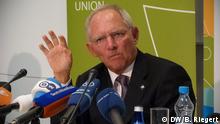 Ο Β.Σόϊμπλε υποστηρίζει ότι υπάρχουν λύσεις για μεταβατική χρηματοδότηση.
Στο μεταξύ συνεχίζεται ο προβληματισμός για τις δυνατότητες
μεταβατικής χρηματοδότησης της Ελλάδας σε περίπτωση που δεν ολοκληρωθούν
εγκαίρως οι διαπραγματεύσεις για την εκταμίευση της επόμενης δόσης.
Ο Β.Σόϊμπλε υποστηρίζει ότι υπάρχουν λύσεις για μεταβατική χρηματοδότηση.
Στο μεταξύ συνεχίζεται ο προβληματισμός για τις δυνατότητες
μεταβατικής χρηματοδότησης της Ελλάδας σε περίπτωση που δεν ολοκληρωθούν
εγκαίρως οι διαπραγματεύσεις για την εκταμίευση της επόμενης δόσης.
Το περιοδικό Focus υποστηρίζει, επικαλούμενο πληροφορίες από περισσότερες πηγές, τις οποίες πάντως δεν κατονομάζει, ότι οι διεθνείς πιστωτές της Ελλάδας εξετάζουν μία ενδεχόμενη προσωρινή παράταση των T-Bills ύψους 3 δισεκατομμυρίων ευρώ που λήγουν στις 16 Νοεμβρίου. Πρόκειται για κρατικά ελληνικά ομόλογα, τα οποία είχαν εκδοθεί τον περασμένο Αύγουστο για να εξασφαλιστεί η μεταβατική χρηματοδότηση της χώρας μέχρι το φθινόπωρο και μετά από κατ΄εξαίρεση έγκριση της Ευρωπαϊκής Κεντρικής Τράπεζας.
Την περασμένη εβδομάδα ο Γερμανός υπουργός Οικονομικών Βόφλγκανγκ Σόϊμπλε είχε δηλώσει ότι «σε θέματα βραχυπρόθεσμης χρηματοδότησης για την Ελλάδα μπορούν να βρεθούν λύσεις», χωρίς πάντως να αναφερθεί σε συγκεκριμένες προτάσεις.
http://www.dw.de/%CF%84%CF%81%CE%AF%CF%84%CE%BF-%CF%80%CE%B1%CE%BA%CE%AD%CF%84%CE%BF-%CE%B3%CE%B9%CE%B1-%CF%84%CE%B7%CE%BD-%CE%B5%CE%BB%CE%BB%CE%AC%CE%B4%CE%B1/a-16353738
Is it true, as some analysts warn that a default and a subsequent withdrawal of Greece from the euro through a domino effect would trigger a global recession?
Greece will remain in the euro. I see no great risk more that there will not be sufficient support to keep Greece in the euro zone. Everyone now understands that the exit of one country from the euro would change the character of the currency area fundamental finding of a monetary union in a system of fixed exchange rates. The latter would lead to later dates again to attack the weakest members.
Do you think the European Central Bank that the bond purchases have a monetary policy background, or is it actually an undercover government financing by the interest is pressed?
The motivation of the ECB for the "Outright Monetary Transaction" program (OMT) is to hold together the euro. As it ECB President Draghi said. In their view, this dramatic move was the only instrument that was still on time.
The mere announcement of possible bond purchases to lower interest rates? Or must buy the ECB soon actually?
We must assume that the determination of the ECB will be tested and the ECB must buy their willingness to prove.
The Bundesbank has heavily criticized. Now is isolated. The ECB may simply leave so left?
There is no shame to be isolated, if done correctly in the matter lies. Bundesbank is the most important economic institution in Germany, has acquired over several decades, an enormous credibility. The ECB is trying to build a correspondingly high level of credibility. When two high-ranking representatives of the Bundesbank, Axel Weber and Juergen Stark, have resigned in protest against the bank's policy, then you should take it very seriously. Mr Draghi has said that he wanted to keep the euro zone at all costs. But the ECB's mandate is to ensure price stability. Such a conflict would never occur to. Nor do I believe that the OMT was the only way to save the euro. An early Troika program for Spain and Italy would have been the right way, but that was probably politically difficult for these countries.
There is growing criticism from various corners of austerity in the Eurozone. Even the IMF warned that a tough austerity plan to damage the economy so strong, so that the target is missed, to reduce deficits. Southerners should reduce spending less?
No, they should not save less, and they should only amplify the structural reforms. Labour markets must be made more flexible, closed professions be opened. The Agenda 2010 can be a model. It needs more competition in product markets. Most important are labor market reforms. Hiring and firing must be easier. Some preceding, but not nearly as much as necessary and as possible. In Italy, the labor market law was passed, but implementation is slow. The belief that you must be more competitive through structural reforms to Germany and other countries, is not yet available everywhere.
Greece should be given more time and stretch their budget targets?
It makes no sense to tighten the fiscal austerity measures even further. Greece is insolvent, despite the rescue package. Greece needs more time, but only for strict conditions. But if the schedule is stretched, must be financed.
Germany is expected to co-finance a third rescue package?
If you want to get the euro in its current form, then the answer is yes. The conditions imposed by the Troika go to the limits of what is politically feasible in Greece. The difficult question of the arrangements envisaged that funding is more new loans or other debt cuts, which would have to participate in the public debt.
But the German government has a strict policy against it, because then the taxpayers will feel heavy losses for the first time ...
Then it will soon be necessary to provide more new loans.
The Greek economy is shrinking for four years, how long will the recession?
Growth in a country with a large informal sector is not easy to grasp statistically. The recession of the formal economy could well continue for three or four years. But that is probably not a correct measure, because of the shadow sector is so large.
Apart from Greece. What are the big problem children in the euro?
It's not so much about individual countries, it is about the overall approach. The bond-buying program, the ECB is ready, but success is not assured. We currently have an environment with extremely low interest rates in the U.S. and Germany. Further expansion of the money supply will not stimulate demand. We have very large deficits in most industrialized countries and very high levels of debt. At best, there will be in Europe in the next five years is very little growth, while. The major emerging economies, all left without much debt, so much better
If the monetary union to a permanent transfer union?
There are three ways to resolve the crisis, resulting from the different competitiveness and too much debt. First, higher inflation in Germany than in other countries, to compensate for the differences in competition. Second, transfer payments, either through the ESM, whether through EU structural funds or by a further socialization of state obligations such as through a direct recapitalization of Spanish banks. Thirdly, radical growth-enhancing structural reforms in the crisis countries. I guess in the end it will be a combination of all three measures. But ultimately, we will not come around to the direct or indirect transfer, if we want to keep the euro zone. The persistent differences in competitiveness are just too great.
http://www.faz.net/aktuell/wirtschaft/wirtschaftspolitik/deutsche-bank-chefvolkswirt-david-folkerts-landau-deutschland-sollte-drittes-hilfspaket-mitfinanzieren-11947818.html
Στο ερώτημα εάν η Ελλάδα έχει ανάγκη από ένα νέο σχέδιο ευρωπαϊκής βοήθειας, ο Ντάβιντ Φόλκερτς-Λαντάου απάντησε: «Εάν επιθυμούμε να διατηρήσουμε το ευρώ υπό την παρούσα μορφή του, τότε η απάντηση είναι ναι. Οι αξιώσεις της Τρόικας έχουν φθάσει στα όρια του τι μπορεί να γίνει πολιτικά ανεκτό στην Ελλάδα».
«Το ακανθώδες ερώτημα είναι πλέον τι είδους μορφή θα πρέπει να λάβει αυτή η χρηματοδότηση: νέες πιστώσεις, ή ένα νέο κούρεμα, στο οποίο θα πρέπει να συμμετάσχουν και οι δημόσιοι πιστωτές;», προσθέτει.
Εάν τα ευρωπαϊκά κράτη δεν θέλουν να ακούν το παραμικρό για μία νέα αναδιάρθρωση του ελληνικού χρέους διότι αυτό θα ήταν συνώνυμο με άμεση απώλεια χρημάτων των ευρωπαίων φορολογούμενων, «τότε σύντομα θα είναι απαραίτητο να χορηγηθούν νέες πιστώσεις», κατά τον Φόλκερτς-Λαντάου.
http://www.protothema.gr/economy/article/?aid=233965
Ένα νέο, τρίτο κατά σειρά πακέτο βοήθειας προς την Ελλάδα προβλέπει ο
επικεφαλής οικονομολόγος της Deutsche Bank Ντάβιντ Φόλκερτς-Λάνταου.
Σε συνέντευξή του στη γερμανική εφημερίδα Frankfurter Allgemeine ο
Γερμανός οικονομολόγος υποστηρίζει ότι η «Η Ελλάδα χρειάζεται
περισσότερο χρόνο, αλλά μόνο έναντι αυστηρών προϋποθέσεων» και ότι «εάν
δοθεί επιμήκυνση, θα πρέπει να εξασφαλιστεί και η χρηματοδότησή της».Σε ερώτηση αν η Γερμανία θα πρέπει να συγχρηματοδοτήσει ένα τρίτο πακέτο, ο Φόλκερτς-Λάνταου δηλώνει χαρακτηριστικά: «αν επιθυμούμε να διατηρήσουμε το ευρώ στη σημερινή μορφή του, τότε η απάντηση είναι ΝΑΙ. Οι όροι της τρόϊκα έχουν φτάσει πλέον στα όρια του πολιτικά εφικτού στην Ελλάδα. Το δύσκολο ερώτημα είναι ποια μορφή θα πρέπει να λάβει αυτή η χρηματοδότηση- δηλαδή είτε νέα δάνεια, είτε ένα νέο κούρεμα για τους πιστωτές του δημοσίου τομέα».
Πάντως σύμφωνα με τον επικεφαλής οικονομολόγο της Deutsche Bank η προτεραιότητα στην Ελλάδα, αλλά και στις άλλες χώρες της νότιας Ευρώπης δεν πρέπει να είναι πλέον οι περικοπές και τα μέτρα λιτότητας, αλλά οι διαρθρωτικές μεταρρυθμίσεις, το άνοιγμα κλειστών επαγγελμάτων, οι αλλαγές στην αγορά εργασίας και όλα εκείνα τα μέτρα που θα τονώσουν τον ελεύθερο ανταγωνισμό και την οικονομική ανάπτυξη.
Mόλις χθες ο επικεφαλής οικονομολόγος της δεύτερης μεγαλύτερης γερμανικής τράπεζας Commerzbank Γιοργκ Κρέμερ, σε συνέντευξή του προς την Deutsche Welle, είχε προβλέψει ότι θα δοθεί και τρίτο πακέτο βοήθειας προς την Ελλάδα.
«Focus»: Νέα T-Bills
Ο Β.Σόϊμπλε υποστηρίζει ότι υπάρχουν λύσεις για μεταβατική χρηματοδότηση.
Το περιοδικό Focus υποστηρίζει, επικαλούμενο πληροφορίες από περισσότερες πηγές, τις οποίες πάντως δεν κατονομάζει, ότι οι διεθνείς πιστωτές της Ελλάδας εξετάζουν μία ενδεχόμενη προσωρινή παράταση των T-Bills ύψους 3 δισεκατομμυρίων ευρώ που λήγουν στις 16 Νοεμβρίου. Πρόκειται για κρατικά ελληνικά ομόλογα, τα οποία είχαν εκδοθεί τον περασμένο Αύγουστο για να εξασφαλιστεί η μεταβατική χρηματοδότηση της χώρας μέχρι το φθινόπωρο και μετά από κατ΄εξαίρεση έγκριση της Ευρωπαϊκής Κεντρικής Τράπεζας.
Την περασμένη εβδομάδα ο Γερμανός υπουργός Οικονομικών Βόφλγκανγκ Σόϊμπλε είχε δηλώσει ότι «σε θέματα βραχυπρόθεσμης χρηματοδότησης για την Ελλάδα μπορούν να βρεθούν λύσεις», χωρίς πάντως να αναφερθεί σε συγκεκριμένες προτάσεις.
http://www.dw.de/%CF%84%CF%81%CE%AF%CF%84%CE%BF-%CF%80%CE%B1%CE%BA%CE%AD%CF%84%CE%BF-%CE%B3%CE%B9%CE%B1-%CF%84%CE%B7%CE%BD-%CE%B5%CE%BB%CE%BB%CE%AC%CE%B4%CE%B1/a-16353738
German Bank chief economist, David Folkerts-Landau, "Germany should help finance the third aid package"
02.11.2012 · The chief economist of Deutsche Bank argued in an interview for Greece to keep the euro area. So that works, Germany should help finance a third rescue package.
Mr. Folkerts-Landau, when was the last time in Greece?
Five weeks ago. I was particularly impressed with how big is the shadow economy that works with cash. The formal economy shrinks. It is increasingly difficult to raise taxes. Citizens lack confidence that their money is used well. Is it true, as some analysts warn that a default and a subsequent withdrawal of Greece from the euro through a domino effect would trigger a global recession?
Greece will remain in the euro. I see no great risk more that there will not be sufficient support to keep Greece in the euro zone. Everyone now understands that the exit of one country from the euro would change the character of the currency area fundamental finding of a monetary union in a system of fixed exchange rates. The latter would lead to later dates again to attack the weakest members.
Do you think the European Central Bank that the bond purchases have a monetary policy background, or is it actually an undercover government financing by the interest is pressed?
The motivation of the ECB for the "Outright Monetary Transaction" program (OMT) is to hold together the euro. As it ECB President Draghi said. In their view, this dramatic move was the only instrument that was still on time.
The mere announcement of possible bond purchases to lower interest rates? Or must buy the ECB soon actually?
We must assume that the determination of the ECB will be tested and the ECB must buy their willingness to prove.
The Bundesbank has heavily criticized. Now is isolated. The ECB may simply leave so left?
There is no shame to be isolated, if done correctly in the matter lies. Bundesbank is the most important economic institution in Germany, has acquired over several decades, an enormous credibility. The ECB is trying to build a correspondingly high level of credibility. When two high-ranking representatives of the Bundesbank, Axel Weber and Juergen Stark, have resigned in protest against the bank's policy, then you should take it very seriously. Mr Draghi has said that he wanted to keep the euro zone at all costs. But the ECB's mandate is to ensure price stability. Such a conflict would never occur to. Nor do I believe that the OMT was the only way to save the euro. An early Troika program for Spain and Italy would have been the right way, but that was probably politically difficult for these countries.
There is growing criticism from various corners of austerity in the Eurozone. Even the IMF warned that a tough austerity plan to damage the economy so strong, so that the target is missed, to reduce deficits. Southerners should reduce spending less?
No, they should not save less, and they should only amplify the structural reforms. Labour markets must be made more flexible, closed professions be opened. The Agenda 2010 can be a model. It needs more competition in product markets. Most important are labor market reforms. Hiring and firing must be easier. Some preceding, but not nearly as much as necessary and as possible. In Italy, the labor market law was passed, but implementation is slow. The belief that you must be more competitive through structural reforms to Germany and other countries, is not yet available everywhere.
Greece should be given more time and stretch their budget targets?
It makes no sense to tighten the fiscal austerity measures even further. Greece is insolvent, despite the rescue package. Greece needs more time, but only for strict conditions. But if the schedule is stretched, must be financed.
Germany is expected to co-finance a third rescue package?
If you want to get the euro in its current form, then the answer is yes. The conditions imposed by the Troika go to the limits of what is politically feasible in Greece. The difficult question of the arrangements envisaged that funding is more new loans or other debt cuts, which would have to participate in the public debt.
But the German government has a strict policy against it, because then the taxpayers will feel heavy losses for the first time ...
Then it will soon be necessary to provide more new loans.
The Greek economy is shrinking for four years, how long will the recession?
Growth in a country with a large informal sector is not easy to grasp statistically. The recession of the formal economy could well continue for three or four years. But that is probably not a correct measure, because of the shadow sector is so large.
Apart from Greece. What are the big problem children in the euro?
It's not so much about individual countries, it is about the overall approach. The bond-buying program, the ECB is ready, but success is not assured. We currently have an environment with extremely low interest rates in the U.S. and Germany. Further expansion of the money supply will not stimulate demand. We have very large deficits in most industrialized countries and very high levels of debt. At best, there will be in Europe in the next five years is very little growth, while. The major emerging economies, all left without much debt, so much better
If the monetary union to a permanent transfer union?
There are three ways to resolve the crisis, resulting from the different competitiveness and too much debt. First, higher inflation in Germany than in other countries, to compensate for the differences in competition. Second, transfer payments, either through the ESM, whether through EU structural funds or by a further socialization of state obligations such as through a direct recapitalization of Spanish banks. Thirdly, radical growth-enhancing structural reforms in the crisis countries. I guess in the end it will be a combination of all three measures. But ultimately, we will not come around to the direct or indirect transfer, if we want to keep the euro zone. The persistent differences in competitiveness are just too great.
http://www.faz.net/aktuell/wirtschaft/wirtschaftspolitik/deutsche-bank-chefvolkswirt-david-folkerts-landau-deutschland-sollte-drittes-hilfspaket-mitfinanzieren-11947818.html





No comments:
Post a Comment